My two weeks in Missoula were coming to an end, and we had been productive. Really productive.
I loved my time there. I had settled into a rhythm of work, walks along the river, conversations, and evenings that seemed to stretch a little longer than they did back home. But as that chapter of the trip came to a close, I was ready for what was next.
For the next four days, I was heading to Yellowstone National Park—one of the places sitting near the very top of my bucket list.
When it comes to wildlife in North America, Yellowstone sits firmly on the beaten path for a reason. Bison, elk, pronghorn, moose, wolves, black bears, grizzlies—the park still supports an incredible collection of large mammals that have disappeared from much of their former range. For someone who spends an unreasonable amount of time thinking about wildlife, it felt a little like heading toward the Super Bowl.
This part of the trip would also be different for another reason: I was going alone.
I love sharing experiences with people. Some of my favorite memories are tied just as much to the person standing beside me as they are to the place itself. But every once in a while, I need solitude too. There is something about being alone long enough for everyone else’s noise to disappear and your own thoughts to become impossible to ignore.
Sometimes that is peaceful.
Sometimes you realize your own thoughts are pretty loud.
Either way, I was ready for it.
Just like the weekend before in Glacier, the computer wasn’t coming with me. Work could wait. Emails could wait. For four days, my priorities were going to be wildlife, landscapes, a camera, and whatever Yellowstone decided to put in front of me.
I picked up the rental car and drove south.
Arriving in Yellowstone
Approaching Yellowstone felt completely different from approaching Glacier.
In Glacier, the mountains had appeared far out on the horizon and slowly grown until they seemed to swallow the road. Yellowstone didn’t announce itself quite like that. Instead, I drove south through Montana toward Gardiner, and before I had even reached town, the wildlife started appearing.
A bighorn sheep.
A couple of cow elk.
I wasn’t even technically in Yellowstone yet, and I was already pumped.
Then came Gardiner, the Yellowstone sign, the famous Roosevelt Arch, and the entrance station. Within a matter of minutes, I went from driving through a small Montana town to officially being inside one of the most recognizable wild places in the world.
Almost immediately, I spotted pronghorn in the distance and then more elk. Naturally, I took far too many pictures.
At the time, every animal felt like an event. I had no idea that over the next few days I would have so many wildlife encounters that eventually I would need to remind myself that I did not, in fact, need another 400 photographs of every bison I saw.
I arrived in the early afternoon, and even though I wanted to start exploring immediately, Mammoth Campground was nearby. I decided the responsible thing to do was set up first.
Tent up. Gear somewhat organized. Good enough.
I was back in the car almost immediately.
My approach to Yellowstone was going to be different from Glacier. Hiking wasn’t the priority this time. I wanted to watch wildlife. I wanted to photograph animals, but even more than that, I wanted to see them interact with the landscape and with one another. I wanted to sit long enough for an animal to stop being a photograph and start being an animal again.
For a few days, the hiking boots could take a back seat.
I was putting on my observation lenses.
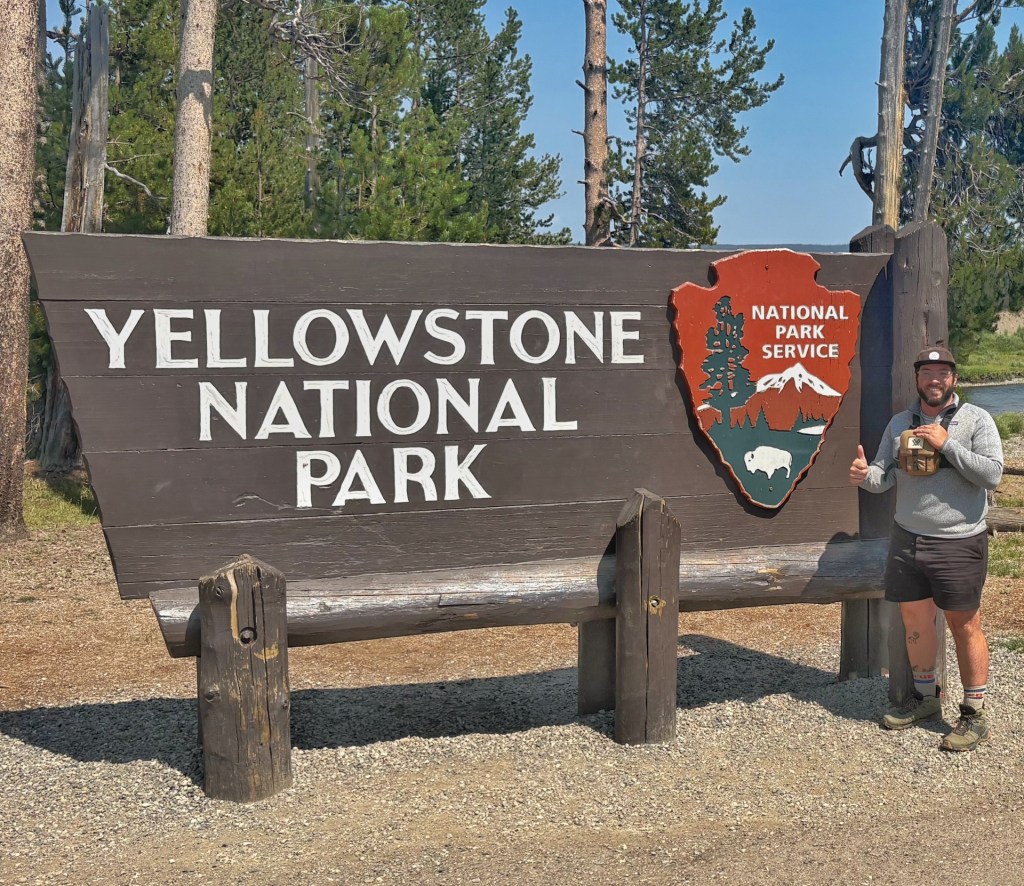
Above: Yellowstone National Park Entrance. Another entrance sign I couldn’t just drive by.
Learning to Watch
The first bison I really stopped for was alone, maybe a hundred meters from the road.
I pulled over, grabbed the camera, and watched as it dropped onto the ground and began dust bathing. It rolled its enormous body through the dirt, stood back up, moved around, and repeated the whole process while I stood there completely fascinated.
I probably watched that one bison for more than half an hour.
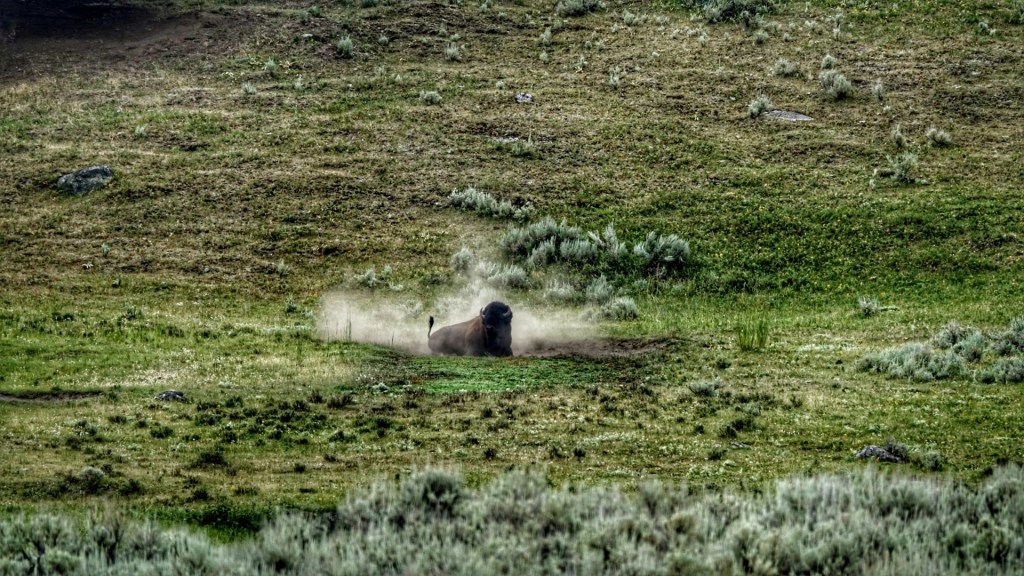
Above: Dust-Bathing Bison (Bison bison). The first bison I really stopped to watch—and the beginning of learning that sometimes the best wildlife encounters happen when you stay a little longer.
Cars would stop behind me. Someone would get out, take a picture, look for a few seconds, and leave. I remember wondering how they could possibly drive away so quickly.
There is a freaking bison right there.
Eventually, I pulled myself away too, only knowing I had much more to see.
Then, over the next few days, I began to understand why everyone else had seemed so casual.
There were bison everywhere.
Sometimes they were little brown dots scattered across a mountainside so far away that binoculars were necessary just to confirm what I was seeing. Other times they walked directly beside my vehicle and looked roughly the size of a minivan.
No matter how many I saw, I never really got over their size. The big bulls looked like they could run through a brick wall if they became mildly inconvenienced by its existence.
Then there were the calves.
Watching them was an entirely different experience. They chased one another, jumped around, got what I can only describe as the zoomies, and headbutted each other as if they were practicing for the day when they would become the massive adults standing nearby.
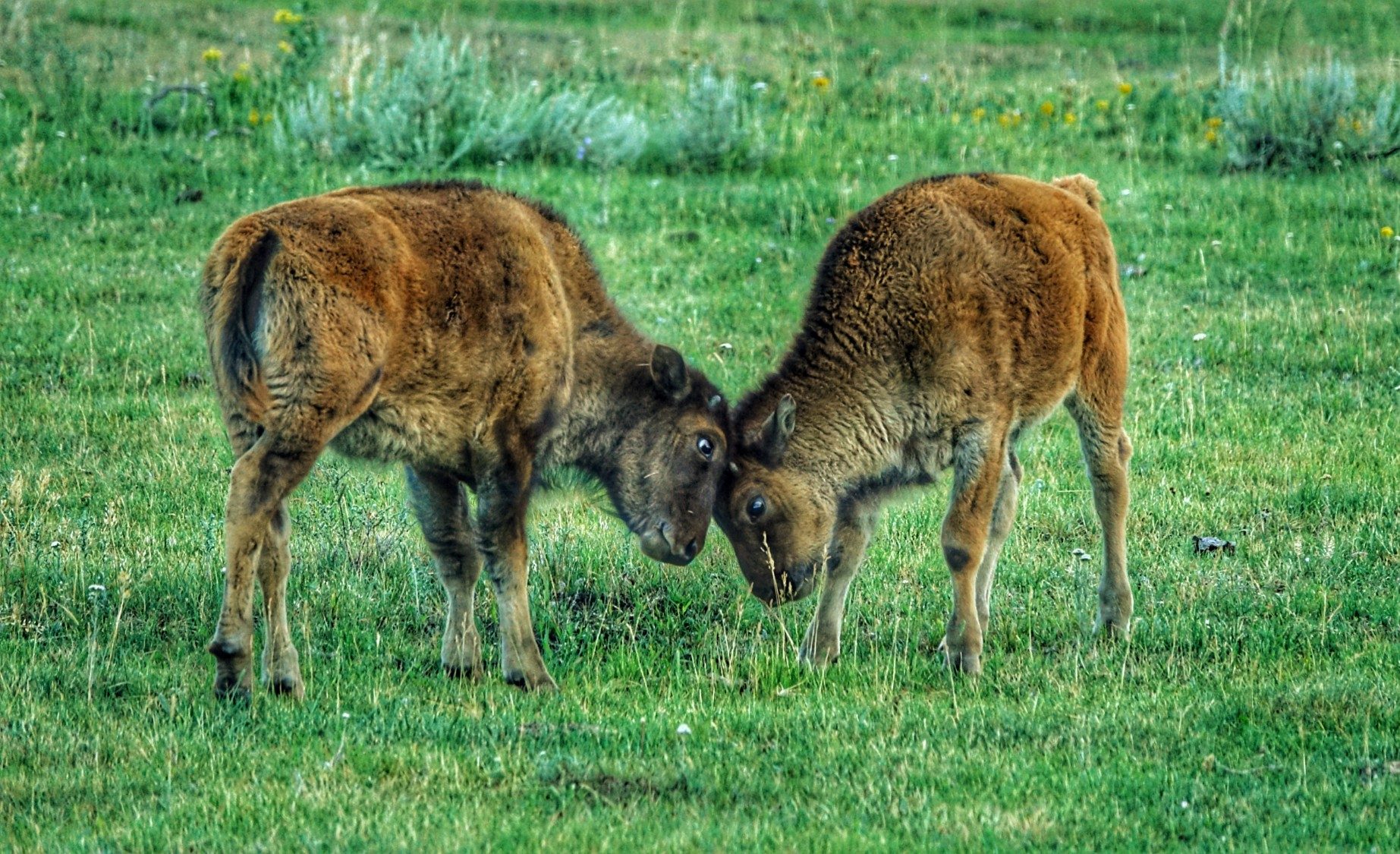
Above: Playful Bison (Bison bison). A little practice for the day when “cute” turns into “roughly the size of a small vehicle.”
Maybe other people eventually stopped pulling over for every bison.
I never completely did.
If watching them meant spending an unreasonable amount of my Yellowstone trip inside a vehicle, I decided I could make that sacrifice.
And, slightly embarrassingly, I spent a lot of time in that vehicle.
Yellowstone is enormous. Its landscapes shift between broad herbaceous valleys, rolling hills, forested mountainsides, rocky formations, rivers, and high country. Add a limited network of main roads, peak-season crowds, bison deciding pavement is an acceptable place to stand, and the occasional bear sighting bringing traffic to a complete stop, and getting from one side of the park to another can take a while.
But those roads also became observation platforms.
Sometimes I drove barely faster than a crawl, scanning every open slope and forest edge for movement. Sometimes I pulled over and watched. Sometimes I joined a line of vehicles staring in the same direction because, in Yellowstone, a cluster of cars usually means one thing:
Someone saw something.
And I wanted to know what.
The Headliners and Everyone Else
Of course I wanted the headliners.
Grizzlies. Black bears. Wolves. Bull elk.
I wanted the same charismatic megafauna that everyone else came hoping to see.
But I also wanted everything else.
Pronghorn were high on my list. We have them in Texas, although not where I work, and I had listened to talks about pronghorn research and read about their ecology without ever spending much time around them. Finally seeing them up close felt a little like putting a face to a name.
These animals are built for speed, yet nearly every pronghorn I saw appeared deeply committed to doing absolutely nothing.
They laid in the grass.
They chewed.
They stared into the distance.
For animals famous for being incredibly fast, they were surprisingly dedicated to conserving energy.
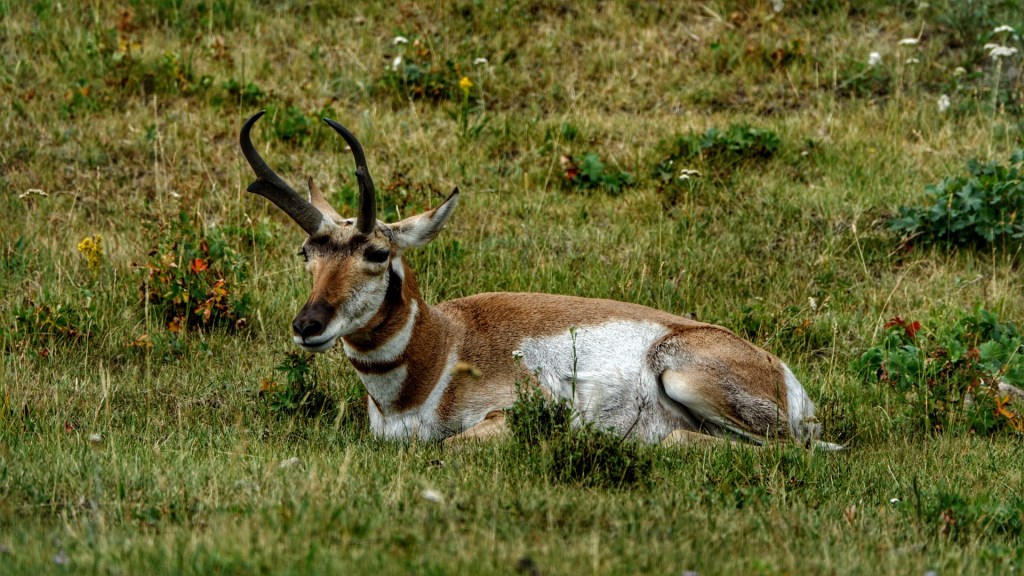
Above: Lazy Pronghorn (Antilocapra americana). Built for incredible speed. Apparently under no obligation to demonstrate it for me.
I kept saying I wanted to see one really run. Then I realized that would probably mean something was chasing it, so maybe lounging around and chewing was the better outcome.
One afternoon, while I was photographing some pronghorn, another visitor walked over and asked what they were.
“What is it? Is it a deer?”
I actually loved the question. Someone had seen an animal they didn’t recognize and asked about it. That is my kind of conversation.
I started explaining that they were pronghorn, but before I could get much further, he turned back toward his family and waved them toward the car.
“I don’t know…some kind of deer.”
And off they went.
I remember standing there thinking, Wait. Come back.
Not because he didn’t know what a pronghorn was. I don’t expect everyone to know that.
What bothered me was that he didn’t seem to want to know.
I wanted to explain why these animals were so interesting, why they weren’t actually deer, and why there was so much more happening in front of him than “some kind of deer.”
That moment stayed with me because curiosity is such a large part of how I experience the world. When I encounter something I don’t understand, my instinct is to ask questions. What is it? Why is it here? How does it work? What makes it different?
And apparently, somewhere along the way, I had started assuming everyone else should want to do the same thing.
Yellowstone was about to make me confront that.
The Beaten Path
Wildlife may have been my priority, but I couldn’t go to Yellowstone without spending time around its geothermal features.
The park shifts dramatically as you move through it, and some areas feel almost otherworldly. Steam rises from the ground. Water bubbles and erupts. Mud boils. Colors appear around hot springs that look almost artificially saturated.
Yellowstone contains thousands upon thousands of hydrothermal features, including the world’s greatest concentration of active geysers. Heat-loving microorganisms also contribute to many of the brilliant colors around the park’s hot springs, creating living bands of color in environments that would be extreme for most other forms of life.
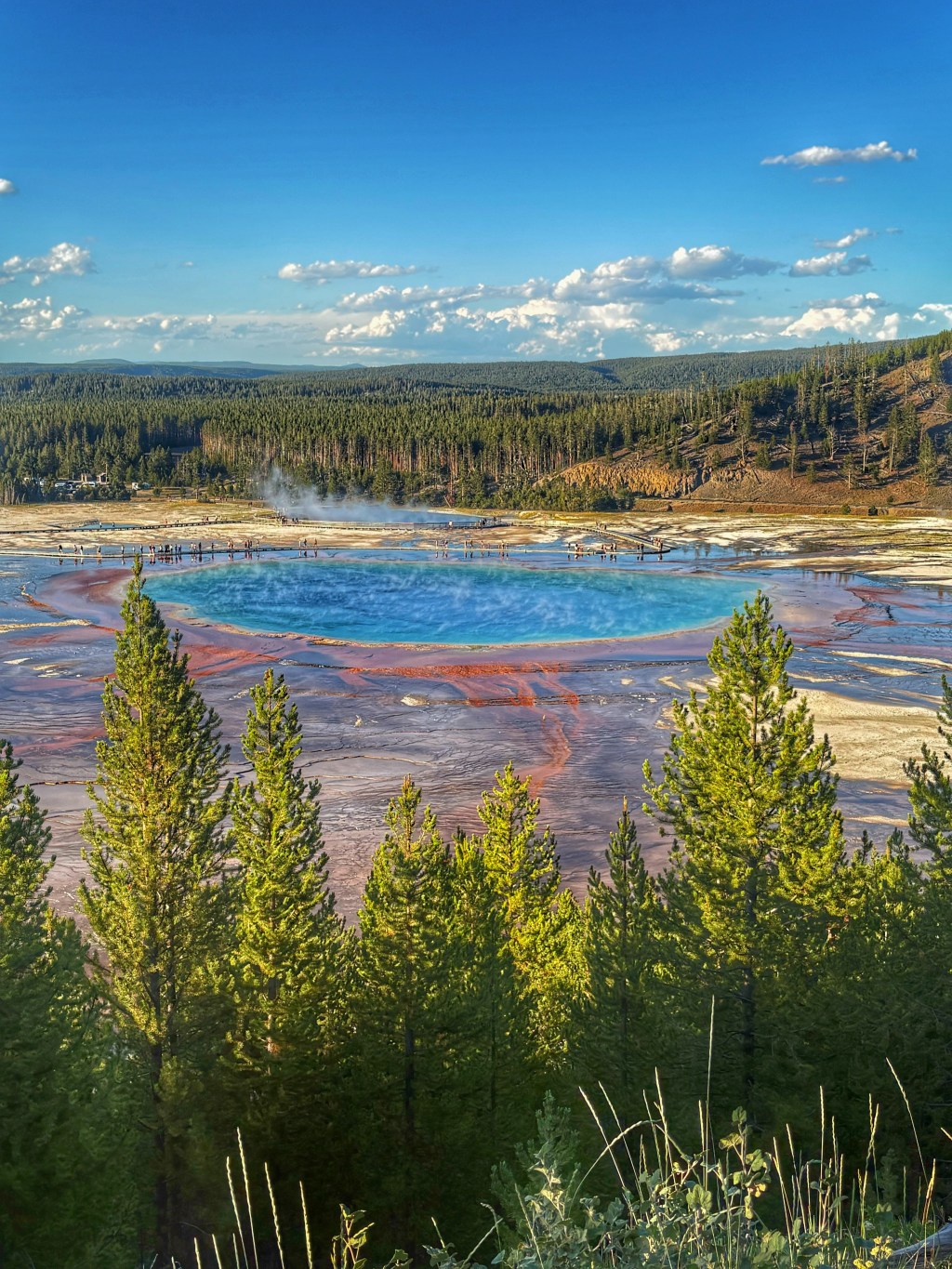
Grand Prismatic Spring completely took my breath away.
Deep blue water transitions into greens, yellows, oranges, and rusty reds while steam drifts across the surface, occasionally hiding parts of the spring before revealing them again. It looked like something someone had designed rather than something that had emerged naturally from the earth. (You can find a picture of Grand Prismatic Spring at the top of the page).
Then, of course, there was Old Faithful.
You don’t go to Yellowstone for the first time and skip Old Faithful.
Both experiences came with another defining feature of Yellowstone in peak season:
People.
A lot of people.
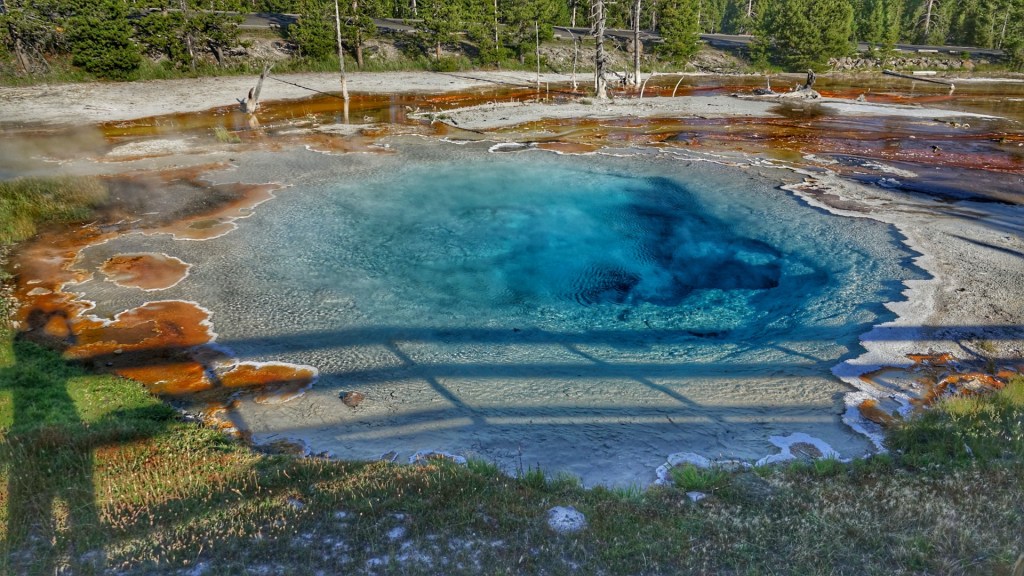
Above: Hydrothermal Pool. Yellowstone’s wildness isn’t limited to what walks across the landscape. Some of it is bubbling right beneath your feet.
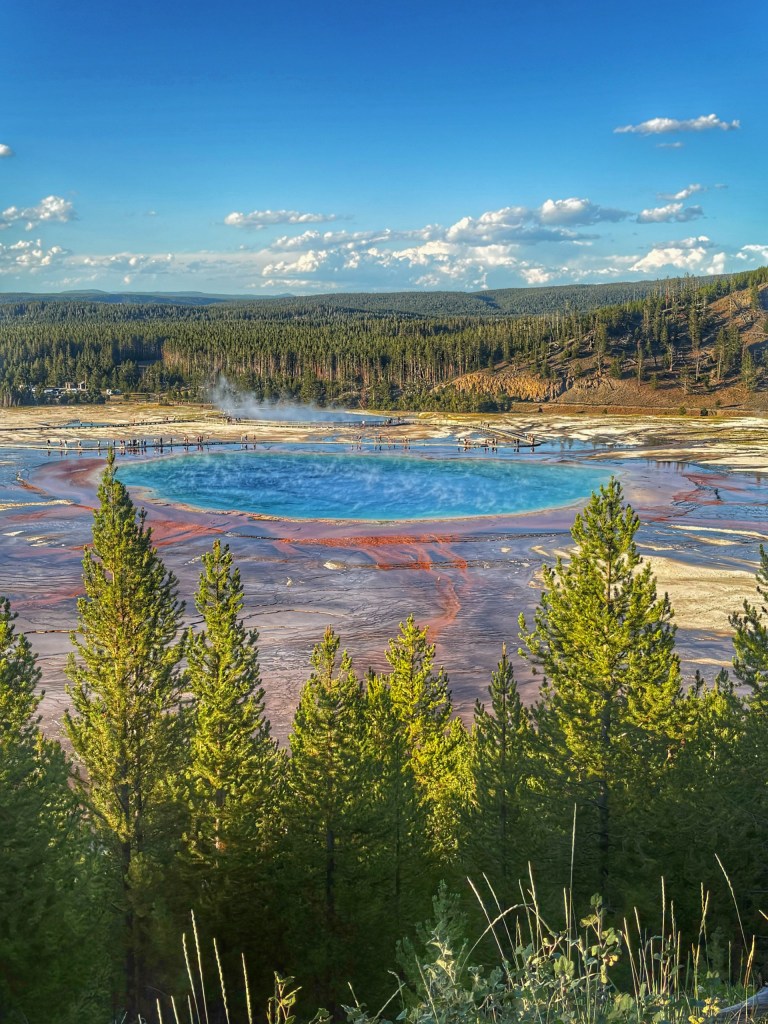
Above: Grand Prismatic Spring. Sometimes the path is beaten for a reason. Grand Prismatic was one of those places. One of my favorite views from Yellowstone.
Boardwalks full of visitors. Parking lots. Lines of vehicles. Phones and cameras held in every direction.
And this is where I am going to be a little vulnerable, because Yellowstone brought out a side of me that I don’t particularly love.
I can get impatient.
Crowds test that patience. Traffic tests it. Someone stopping in a place that backs up fifty cars behind them really tests it.
There were moments when I caught myself focusing more on what other people were doing than on the place I had traveled all the way to experience.
Why are you stopping there?
Why aren’t you pulling over?
Why would you walk that close?
How can you look at this for twelve seconds and leave?
Some of those frustrations were legitimate safety or etiquette concerns. Others were simply me deciding that people weren’t experiencing Yellowstone correctly.
And that part was on me.
The pronghorn encounter had exposed it first. I didn’t expect that visitor to know what he was looking at. What frustrated me was his lack of curiosity because curiosity matters deeply to me.
But that doesn’t mean it has to matter to everyone in the same way.
Put me in an art gallery and there are probably paintings I would admire for fifteen seconds before moving on. Meanwhile, someone standing beside me might spend twenty minutes studying the brushstrokes, history, technique, symbolism, and everything else I completely failed to notice.
They could look at me and think, How can he just walk away from that?
But that’s just me, and we don’t all stop for the same things.
My love for wildlife and the natural world allows it to catch my attention. Someone else’s background might make them notice things I walk right past. One person may come to Yellowstone for wolves. Someone else may have dreamed their entire life about seeing Old Faithful erupt. Another person might care more about geology, plants, history, photography, or simply taking their kids somewhere they themselves never had the opportunity to visit.
There is something beautiful about those differences.
I didn’t need to care less deeply about wildlife. I just needed to stop treating my own way of caring as the standard everyone else should meet.
That was humbling.
It also complicated the frustration I felt about tourism itself.
Yellowstone receives enormous numbers of visitors, and that access undeniably brings traffic, infrastructure, disturbance, crowding, and pressure on the landscape. At the same time, access is part of how people develop relationships with places like this in the first place.
A child who sees their first bison from the backseat of a car may remember it forever.
Someone who knows absolutely nothing about wolves may look through a spotting scope and suddenly want to learn.
A person who has never stood in a wild landscape may leave Yellowstone caring a little more about protecting one.
Maybe a ten-second look is not always the end of someone’s appreciation.
Maybe sometimes it is the beginning.
I didn’t have to enjoy the traffic to understand why the road was crowded.
Once again, the path was beaten for a reason.
Yellowstone is freaking incredible.
Quick Sidebar…Why Is It Called Yellowstone?
With all the yellow, orange, and rust-colored rock surrounding Yellowstone’s hot springs, canyons, and geothermal areas, it would be pretty easy to assume that is where the park got its name.
I definitely did.
But Yellowstone National Park actually takes its name from the Yellowstone River. The name traces back to Indigenous people of the region, whose name for the river was later translated as “Yellow Stone River,” likely referring to yellow sandstone bluffs found farther downstream. French traders later translated the name, and eventually the English version—Yellowstone—stuck.
So the colorful geothermal landscape is not actually what gave Yellowstone its name.
It is just a very convincing coincidence.
Standing above the river, though, with yellow and orange rock lining the canyon walls, it is not hard to see why the assumption feels so natural.
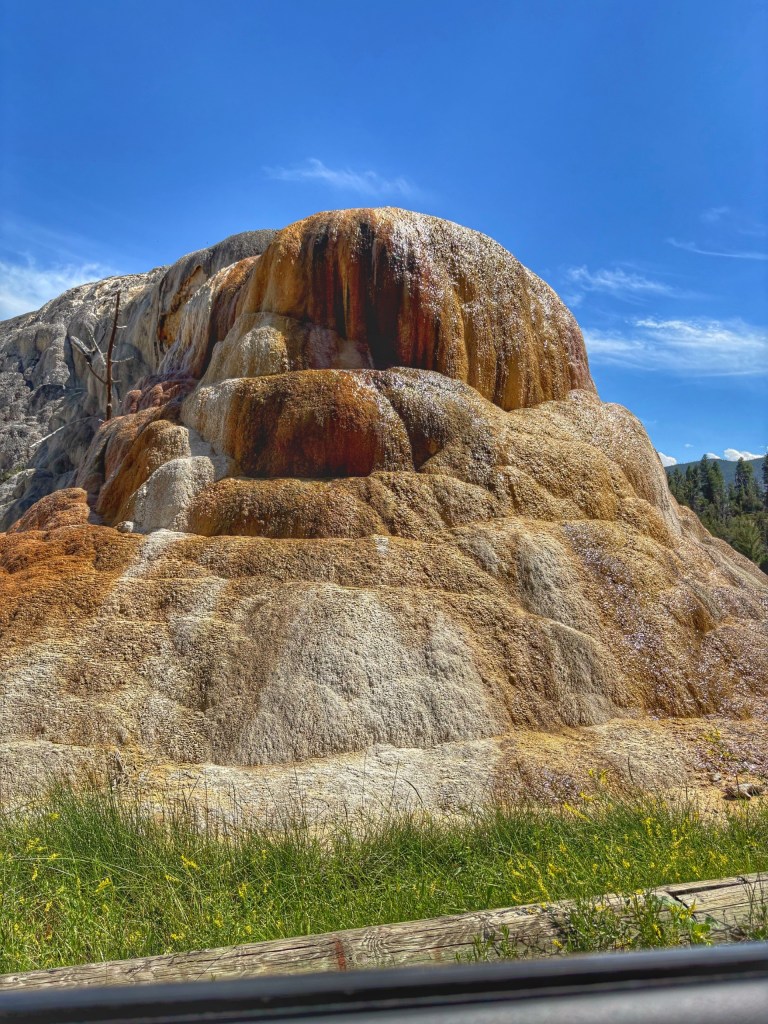
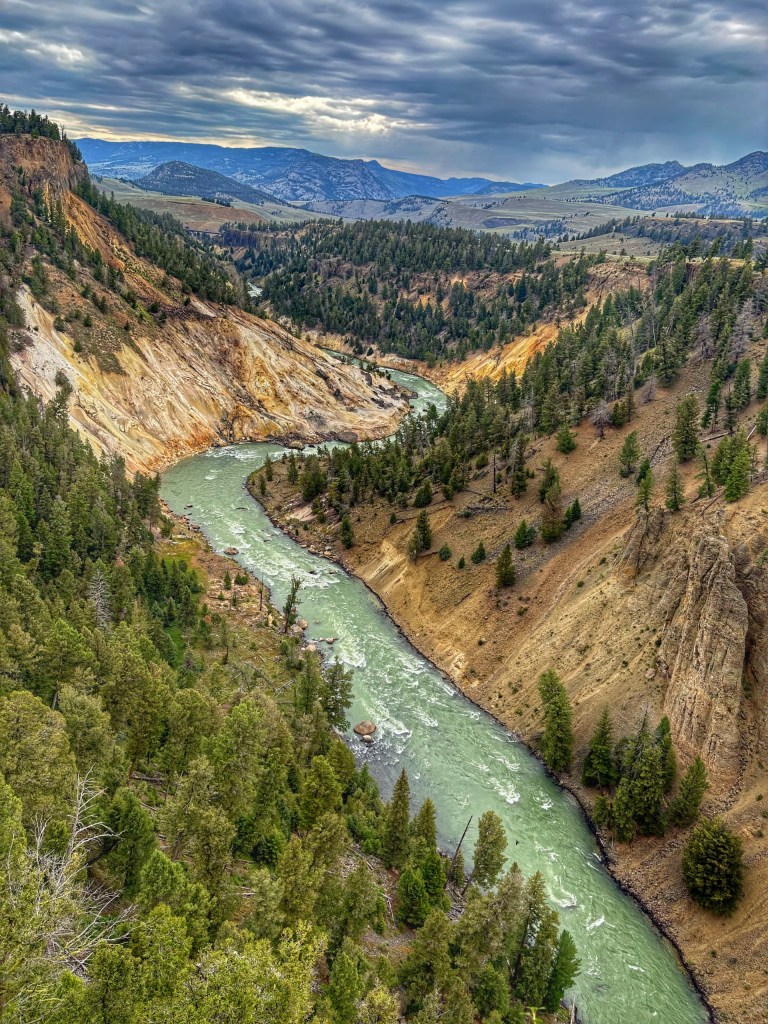
Above (left): Travertine Terraces. Water, heat, minerals, and time—another reminder that Yellowstone is constantly being shaped, even when it appears still. Above (right): The Yellowstone River. With yellow and orange rock surrounding the Yellowstone River, my incorrect theory about the park’s name at least felt pretty convincing.
Wildlife on Its Own Terms
Once I checked myself and stopped paying attention to how everyone else was experiencing Yellowstone, I could get back to the reason I had come in the first place.
Experiencing animals being animals.
One of my favorite encounters was a cow moose and her calf moving through a meadow. Nothing dramatic happened. They fed, wandered through the grass, and looked around while the calf stayed close to its mother.
I love watching mothers and their offspring interact. There is something recognizable about the relationship even across species. The calf would explore a little and then move closer again, using its mother almost like a moving point of safety in the landscape.
It didn’t need to become anything more than that.
I took pictures and watched.
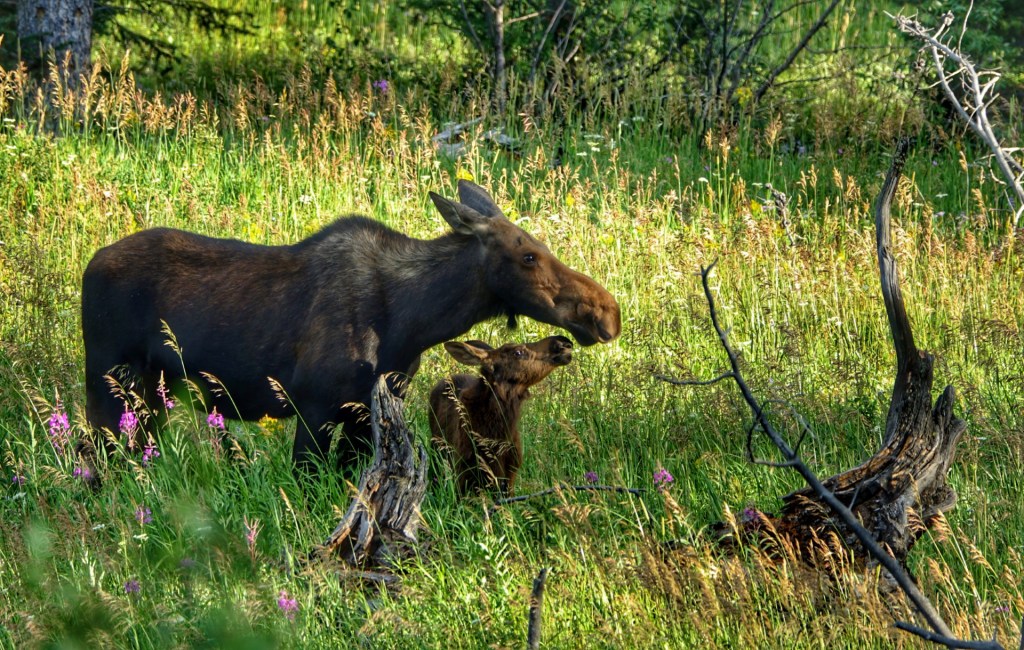
Above: Momma Knows Best (Alces alces). Not every wildlife encounter needs drama. Sometimes watching a calf stay close to its mother is more than enough.
That encounter also captured something I love about wildlife photography. Some of the best moments aren’t dramatic. They don’t need a predator, a chase, or some rare behavior. Sometimes a photograph simply gives you an excuse to pay attention longer.
Later in the trip, I finally found bull elk after trying to photograph them for several days. They were moving across a mountainside as the light began to fade, and I started trying to anticipate where they might go.
I ran to the other side, hoping I could get ahead of them and catch them along the ridge.
For once, the plan more or less worked.
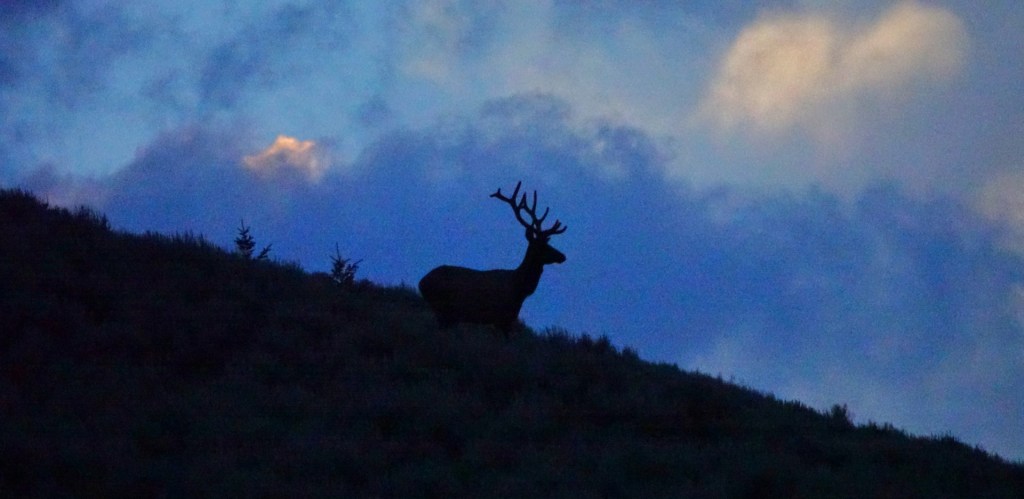
Above: A Sunset Elk (Cervus canadensis). Several days of looking, a little guessing about where they were headed, and one of those rare times the plan actually worked.
That “more or less” describes a lot of wildlife photography.
You can understand behavior, choose a location, carry the right equipment, and put yourself in the best position possible, but the animal still gets the final say.
A black bear made that lesson even clearer.
I was driving one of the quieter roads in the park where there was almost no traffic. For once, I could move at my own pace—sometimes only a couple of miles per hour—scanning every opening, hillside, and forest edge for movement.
Eventually, I rounded a bend and found another vehicle stopped ahead of me. The people inside pointed down over the edge.
A black bear suddenly came up over the ridge almost beside my vehicle.
I grabbed the camera and started photographing as it climbed away from the road. Eventually, the other car left and it was just the bear and me.
For a while, my photographic opportunity consisted primarily of the bear’s rear end disappearing uphill.
Still cool.
Not exactly National Geographic.
Then the bear stopped.
It turned.
Instead of continuing away, it moved across an old fallen log, giving me exactly the kind of photograph I had been hoping for.
I started shooting.
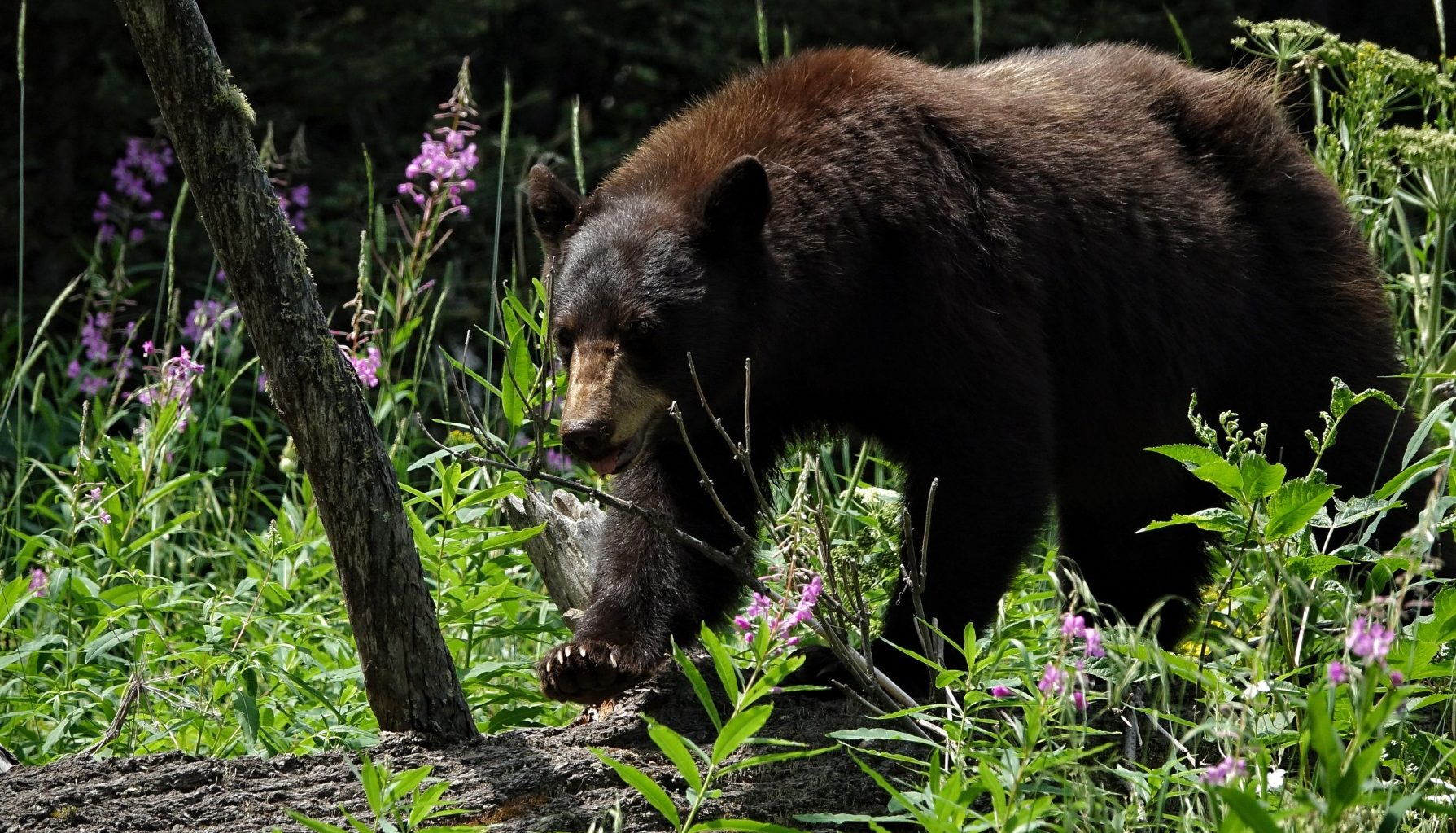
Above: Black Bear (Ursus americanus) in the Wildflowers. I could choose the road, carry the camera, and be ready. I couldn’t make the bear turn around. That part was a gift.
That photograph became one of my favorites from the entire trip.
Sometimes wildlife photography feels like skill. Sometimes it feels like patience. Sometimes it is plain old luck.
And every once in a while, a moment feels like something else entirely.
A gift.
I could put myself in the right place. I could carry the camera. I could pay attention and be ready.
But I couldn’t make that bear turn around.
For a few seconds, it was just me, a bear, an old fallen tree, and a moment I never could have choreographed.
Sometimes I think God gives us little gifts like that.
But we still have to be paying attention enough to notice them.
Getting Out of the Car
After spending so much time searching for wildlife from behind a windshield, eventually I needed to get out. I needed to stretch my legs, avoid the traffic, and explore. Those hiking boots need to be laced up.
I picked a trail, packed what I needed, grabbed the bear spray, and headed out.
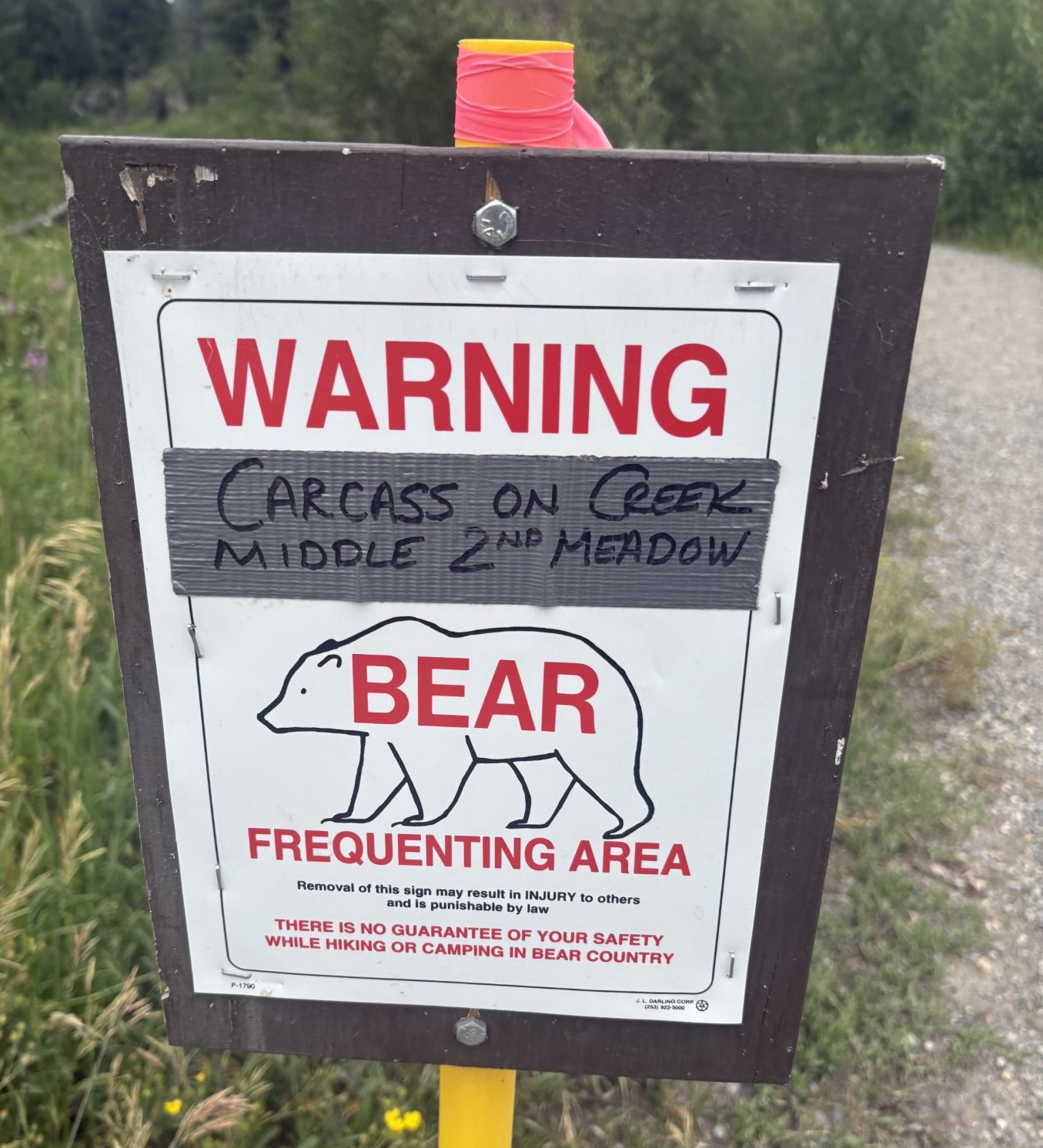
Near the beginning of the trail was a warning that a bear had been seen repeatedly over the previous few days because there was a carcass somewhere near one of the meadows.
My first thought was something along the lines of:
Oh cool. Maybe I’ll see a grizzly.
That enthusiasm faded surprisingly quickly once I was actually hiking alone toward an area where a grizzly had recently been feeding.
Yes, I had bear spray.
At that particular moment, it felt roughly equivalent to walking into battle armed with aerosol sunscreen.
Suddenly, every noise mattered.
Every dark patch near the trees deserved a second look.
I became extremely aware of how far I was from the road and how little I could see into the vegetation around me.
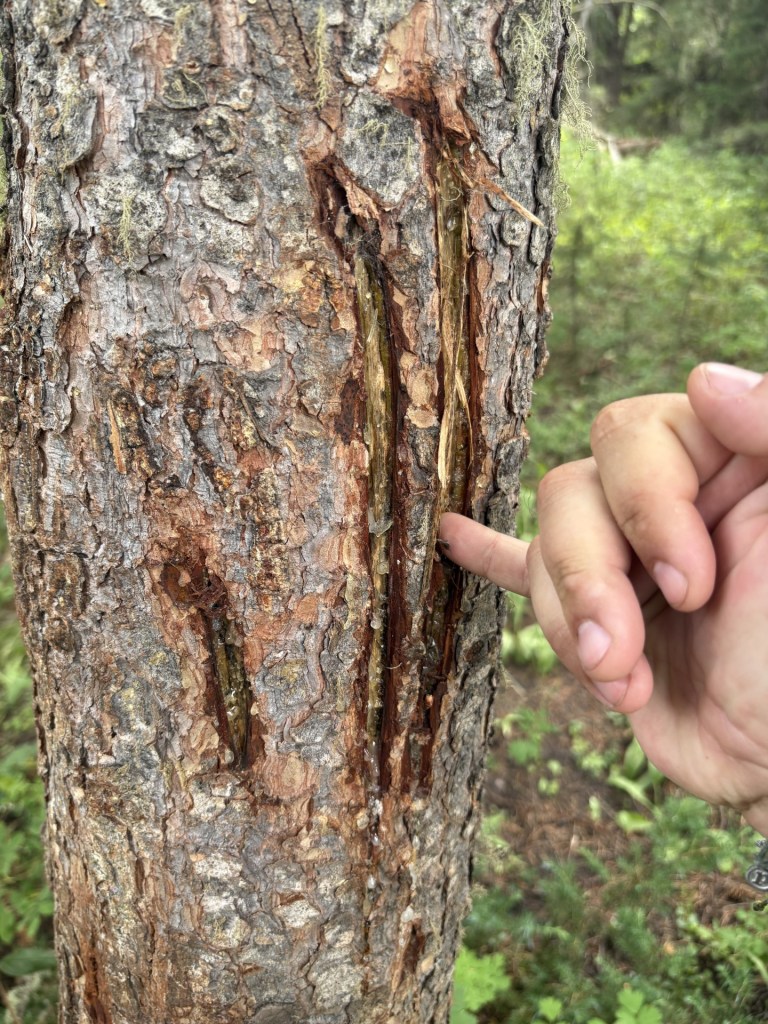
Then I came across a tree that appeared to have been recently used as a grizzly rub. The claw marks were deep enough to make the warnings at the trailhead feel considerably less theoretical.
I kept going.
Eventually, I passed some other hikers and my nerves settled a little. Then the trail opened into a broad meadow with a creek winding through it, rocky hills rising through and around the valley, and forest bordering the edges.
Directly in my path stood a group of bison.
I assessed the situation and made what I believe wildlife professionals call a sound business decision.
I was not walking through them.
Instead, I climbed onto the rocks and sat down.
For about an hour, I watched.
There was no traffic, no line of vehicles, no boardwalk, and no crowd accumulating because someone had spotted an animal. Other than a small emergency cabin in the distance, there wasn’t much visible evidence of modern infrastructure at all.
It was just me, the meadow, the bison, and whatever else may have been standing along that forest edge that I couldn’t see.
That last part was slightly less comforting.
But the experience felt completely different from watching bison beside the road.
And it made me wonder:
Were these bison somehow more wild?
They were the same species. The roadside bison weren’t domesticated simply because they had learned to tolerate vehicles. They were free-ranging animals making their own decisions in a landscape that happened to contain roads and people.
Yet the bison in front of me felt different.
Maybe the difference wasn’t the animals.
Maybe it was me.
Near the road, I was experiencing wildlife through a windshield, a pullout, a camera lens, and infrastructure designed to make the landscape accessible to me.
A couple of miles away, the landscape stopped accommodating me.
The bison stood where they wanted, so I changed my route.
The grizzly warning mattered.
The trail did not guarantee my safety.
Something could be watching me from the forest while I remained completely unaware of it.
For thousands of years before Yellowstone became a national park, Indigenous peoples hunted, gathered, traveled through, and maintained relationships with this landscape. This had never been a place without people.
What disappeared for me in that meadow wasn’t human history.
It was the feeling that the landscape had been arranged around human convenience.
For that hour, I wasn’t driving through the bison’s world.
I was sitting inside it.
And I wasn’t the one making the rules.
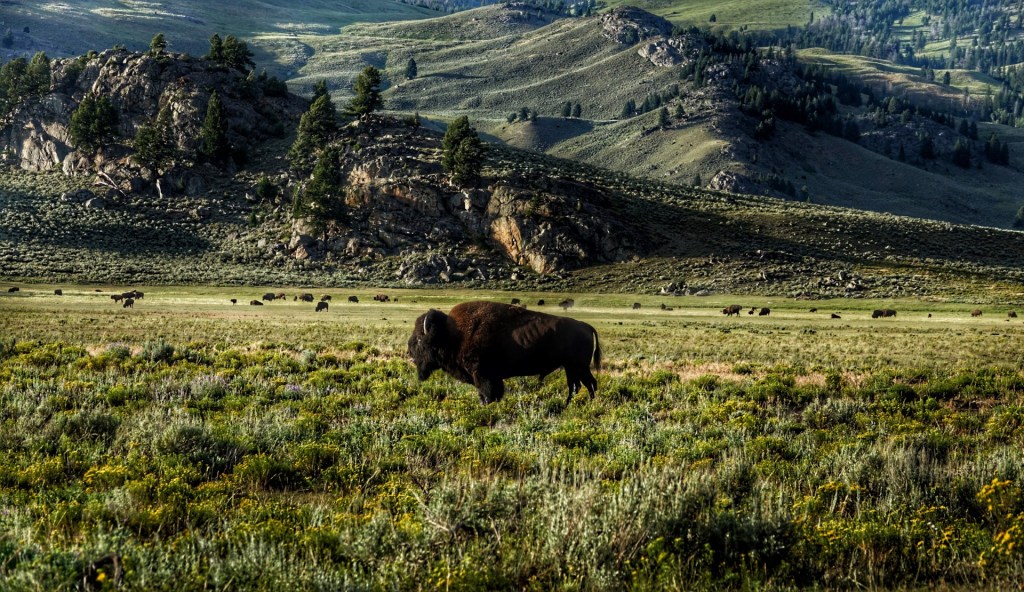
Above: The Backcountry Bison (Bison bison). Same animal. Same park. Somehow, away from the road, it felt completely different. Maybe the difference wasn’t the bison. Maybe it was me.
The Loudness of Solitude
Being alone for four days turned out to be interesting for reasons that had nothing to do with wildlife.
I know I talk to myself, but I never realized how much.
Apparently, when my brain is moving a million miles a minute (which it usually is) and there is no one else around to participate, my mouth decides it should join the conversation.
I narrated things.
I reacted out loud.
I spoke to animals that had absolutely no interest in responding.
I asked myself questions and occasionally answered them.
At one point, I became so annoyed with myself that I literally told myself to shut up.
There is something funny about seeking solitude and discovering that the loudest person in Yellowstone followed you there.
But underneath the humor, I think I needed those days.
Solitude isn’t always quiet. The natural world can be loud in its own way—wind moving through the grass, water running somewhere out of sight, insects humming, animals moving through the brush, or a raven calling from a nearby tree as if it had something to add to the conversation.
But those sounds felt different from the noise of everyday life. There were no overlapping conversations, car horns, barking dogs, televisions, notifications, or constant movement competing for my attention. The sounds around me were still there, but they didn’t seem to demand anything from me.
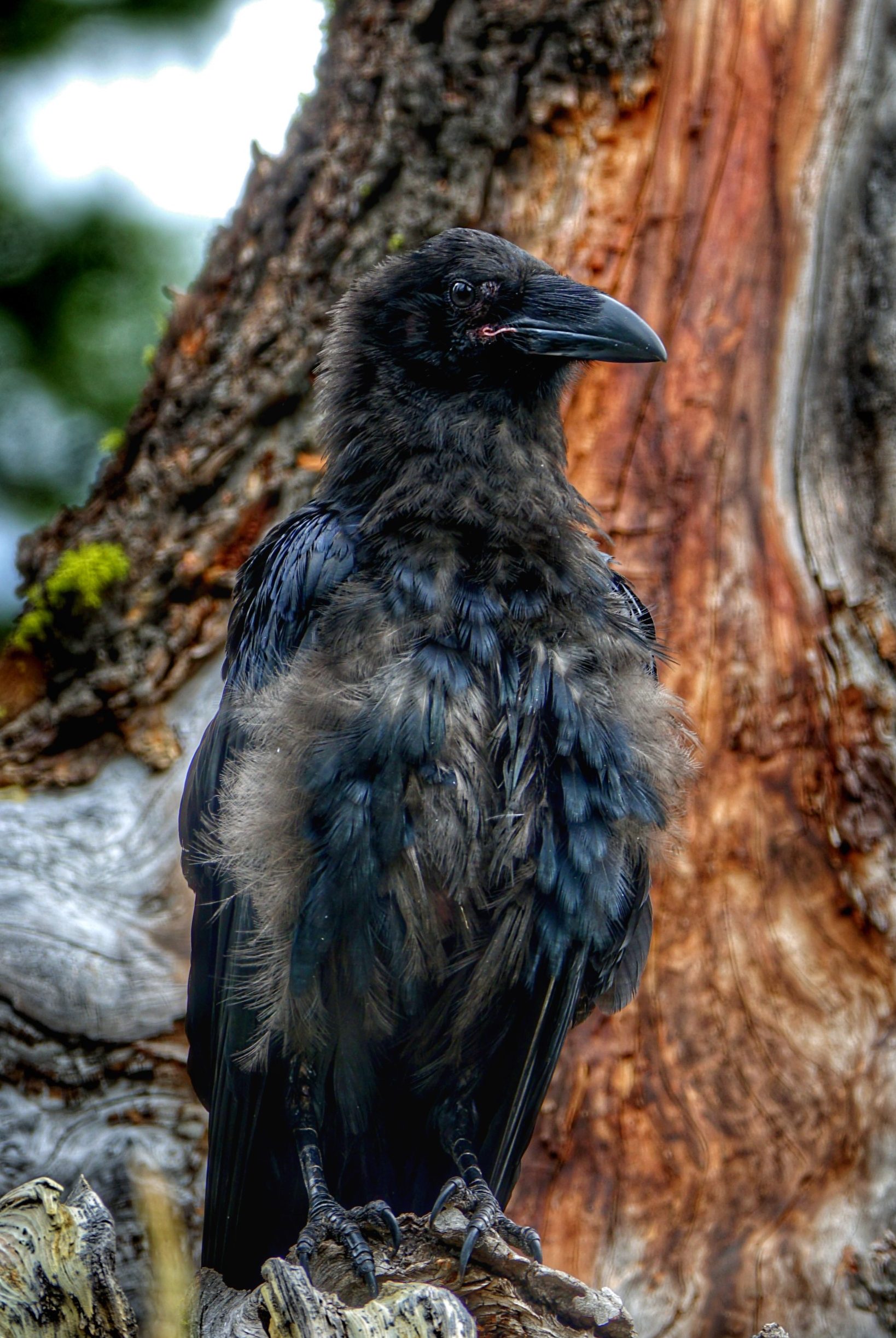
Above: Common Raven (Corvus corax). Yellowstone wasn’t silent. It was just a different kind of noise.
Maybe that is what I am actually looking for when I seek solitude. Not silence, but a break from all the everyday distractions competing for my attention. When that noise fades, I can pay closer attention to the natural world around me—and the thoughts in my own head finally have enough room to sort themselves out instead of bouncing around like a pinball machine with every light flashing at once.
For four days, there were no emails, no computer, and nobody else’s schedule to consider. There wasn’t even cell phone service. If I wanted to spend forty-five minutes watching a bison roll in the dirt, I could. If I wanted to drive two miles per hour while scanning a hillside, there was nobody in the passenger seat asking when we were going to get somewhere.
I could sit on a rock because bison blocked my trail and let the day rearrange itself.
I could wait.
That ended up being important, because Yellowstone had spent much of the trip exposing how impatient I could be.
Looking for Wolves
Wolves have been one of my favorite animals for as long as I can remember, and I had never seen one in the wild.
So, naturally, I became mildly obsessed.
I had been getting up around 4 a.m. and heading toward Lamar Valley, trying to be there while the wolves were most likely to be active. One of the Yellowstone employees had described an area where people regularly watched a pack.
I thought I understood her directions. I did not.
Morning after morning, I went looking. Nothing.
I saw incredible sunrises and plenty of other wildlife, but the wolves remained absent.
On my final morning in Yellowstone, I decided I was going to make one last attempt. Instead of sitting beside the road, I started walking. I followed what I thought were the directions I had been given, listened for sounds, followed game trails, and found enough bones scattered around to occasionally wonder whether I was searching for wolves or volunteering to become part of the food web.
Hours passed and eventually, I accepted defeat.
The sun was rising across the landscape, and I started coming to terms with the possibility that Yellowstone simply wasn’t going to give me wolves this time.
I didn’t particularly like that conclusion, but I was trying to accept it.
I returned to my car and decided to make one final drive through Lamar Valley before leaving.
About three minutes later, I found the exact place the park employee had been trying to describe.
Cars lined one side of the road. People carrying spotting scopes were scattered across the rolling hills on the other.
I had apparently spent several mornings doing everything except going to the correct place. I didn’t see the cars on the side of the road other days, becuase, I was simply too early. I was beating the crowd.
Fantastic.
It was later than the best viewing hours, but people were still watching, so I parked and joined them. I walked farther out onto the hills, talked with different groups, and asked what they had seen.
People generally knew where the wolves were resting, but nothing had been visible for a while.
I only had binoculars.
Everyone around me seemed equipped with spotting scopes capable of identifying individual hairs on a wolf from another zip code.
But I was there.
I had what I had.
And I wasn’t leaving.
So I waited.
After all the rushing, searching, driving, waking up early, following bad directions, and trying to make the experience happen, there was suddenly nothing left for me to do.
Just wait.
Eventually, someone spotted movement.
A black yearling emerged onto a distant hillside.
To anyone driving past, it probably would have looked like a black speck.
To me, it was a wolf.
A wild wolf.
I could not stop smiling.
A coyote appeared nearby and spent some time heckling the yearling. Seeing them relatively close to one another made the difference in size immediately obvious. I was in awe of the size difference, even from across the valley. I kept wondering whether the wolf would eventually decide it had enough, but for the most part it seemed remarkably uninterested in whatever argument the coyote was trying to start.
Then two pups came out.
Wild wolf puppies.
At that point, Yellowstone was providing me one of those moments that seemed like a gift from God.
Then somehow it got better.
The black yearling found an elk antler, picked it up, and carried it back toward the pups. He did this with ease. If you have ever held an elk antler, you now how heavy they can be. Once again, I just watched in awe.
After days of trying to force this experience into existence, I was standing on a hillside watching a young wild wolf carry an antler back toward two pups.
All I could do was smile.
I stayed there talking with people who lived nearby and others who had spent far more time watching these animals than I ever could in four days. They knew the landscape, understood the pack’s routines, and could interpret little behaviors that I was seeing for the first time.
There was so much more to learn.
And suddenly four days felt incredibly short.
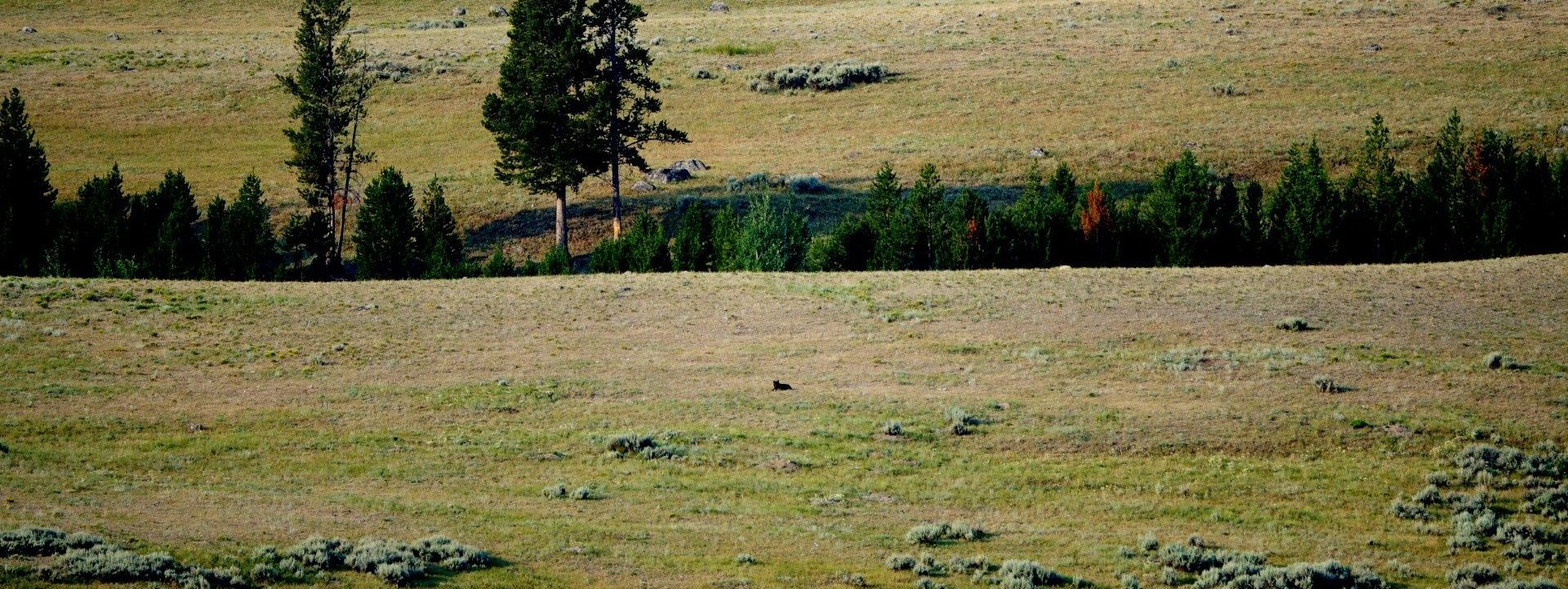
Above: My First Wild Wolf (Canis lupus). The black spot in the middle. But for me, a moment I won’t forget.
Is the Wild Still Wild?
I came to Yellowstone expecting wildness.
What I found was more complicated.
There were roads running through valleys, campgrounds full of people, parking lots around geothermal areas, boardwalks guiding visitors through fragile landscapes, traffic jams caused by bears, bison walking between vehicles, scientists monitoring wildlife, and rangers managing millions of interactions between people and a place that can still be dangerous.
At different points during the trip, I found myself wondering whether all of that human presence had diluted the very thing everyone had come to experience.
Is the wild still wild when millions of people drive through it?
Are bison still wild when they barely react to vehicles?
Is a wolf still wild when people know where its family rests and gather every morning hoping to see it?
Can a place be intensely managed and still genuinely wild?
By the end of the trip, I started wondering whether I had been asking the wrong question.
Maybe wildness was never synonymous with the absence of humans.
People have relationships with this landscape stretching back thousands of years, long before Yellowstone became a national park. Today, Tribal Nations continue to maintain ancestral and modern connections to these lands. Human presence is not new.
What is relatively new is the scale and nature of that presence: roads, vehicles, infrastructure, cameras, crowds, and the systems required to make an enormous wild landscape accessible to millions of people.
Maybe wildness isn’t only defined by whether humans are present.
Maybe it has more to do with whether everything around us still retains some autonomy from us.
The bison crossed the road when they wanted.
The grizzly stayed hidden.
The bear turned around because it chose to.
The wolves didn’t care that I had gotten out of bed at 4 a.m. three mornings in a row.
The geothermal system beneath Yellowstone continues moving heat and water through the earth without consulting any of us.
We influence Yellowstone enormously.
Our presence can alter animal behavior, change landscapes, create disturbance, and leave consequences that extend well beyond the moment we are there. That influence gives us an enormous responsibility.
But influence is not the same thing as control
Perhaps that is part of what makes Yellowstone still feel wild.
The park also challenged my need for control in another way—through the people around me.
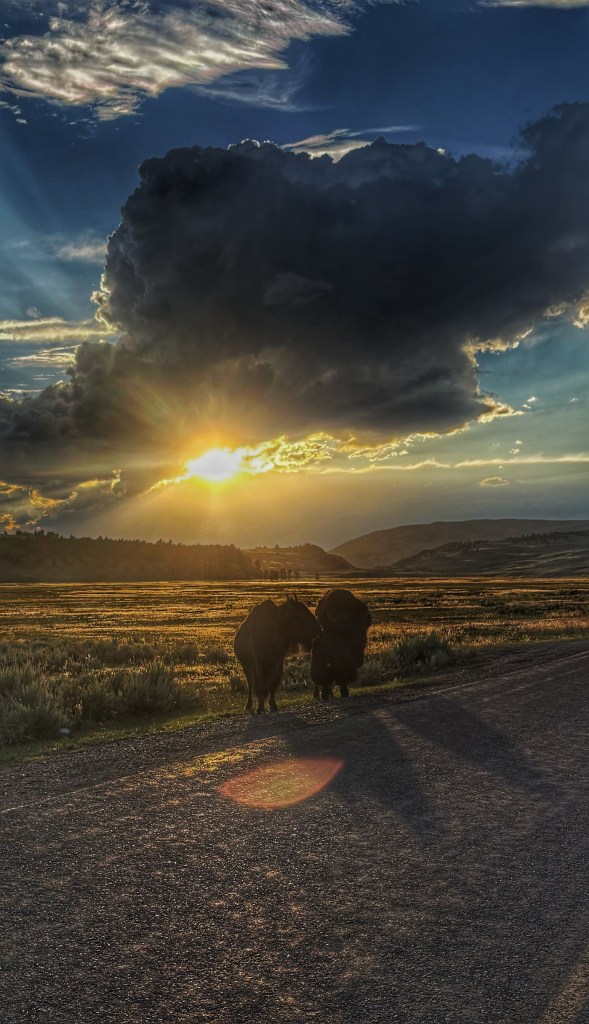
Above: The Sunset Couple. A couple Yellowstone locals taking the scenic route at sunset.
I couldn’t make the bear turn around.
I couldn’t make the wolves appear.
I couldn’t make the bison move out of my path.
And I couldn’t make everyone else experience Yellowstone the way I thought they should.
That may have been the harder lesson.
It is easy for me to say that I value differences when those differences are abstract. It is harder when I am sitting in traffic thinking someone in front of me is being inconsiderate or watching someone walk away from an animal I find fascinating.
But people don’t owe me my version of curiosity.
They don’t have to stop where I stop, ask the questions I ask, or find meaning in the same things.
That doesn’t mean I stop caring about safety, responsible recreation, wildlife disturbance, or protecting the landscape. Those things matter.
It means I have to separate genuine concern from my own preferences.
Maybe humility is partly recognizing that distinction.
I can know a lot about wildlife and still have plenty to learn about people.
I can care deeply about Yellowstone and still not own the correct way to experience it.
I can want others to become curious without demanding that they become curious about the same things I am.
And maybe there is something beautiful about the fact that we all walk into these places carrying different histories, interests, questions, and ways of seeing.
Yellowstone gave me four days of contradictions.
Crowds and solitude.
Roads and wild landscapes.
Animals surrounded by cameras and animals disappearing into country where nobody could find them.
Impatience with people followed by hours of patiently waiting for a black speck to appear on a distant hillside.
A landscape managed intensely by humans where a herd of bison can still walk into the road and bring the entire human system to a halt.
Maybe wildness isn’t something that vanishes the moment people arrive.
Maybe it persists wherever there is still something beyond our complete control.
Something with its own agency.
Something that can surprise us.
Something that doesn’t perform simply because we showed up expecting it to.
Yellowstone isn’t untouched.
It isn’t free from human influence.
And it shouldn’t be romanticized as a landscape that has existed apart from people.
But it still refuses to belong entirely to us.
I think there is something beautifully wild about that.
Questions I’m Carrying With Me
What does wild actually mean? Does human presence inherently diminish wildness, or can people exist within a landscape without needing to dominate it?
If access to wild places helps people care about them, how do we balance that benefit with the impacts that visitation inevitably creates?
Do I sometimes confuse knowledge with appreciation?
Why do I sometimes expect other people to be curious about the same things I am? What am I walking past in their world that they might find extraordinary?
Were the bison I watched away from the road actually more wild than the ones walking between vehicles—or did removing the infrastructure simply make me feel more like a visitor in their world?
How much of wildlife photography, travel, and life itself comes down to putting ourselves in the right place and being prepared—and how much requires accepting that we cannot control what happens once we get there?
How often do I spend so much time trying to force the experience I want that I miss the gift already unfolding in front of me?
And if patience made room for one of my favorite moments in Yellowstone, what else in my life am I rushing that might be asking me simply to wait?
I don’t know the answers.
Just food for thought.
If You Want to Explore a Little Deeper
- Why Is It Called Yellowstone? — National Park Service — where the name “Yellowstone” came from and how it became associated with the river and park.
- Hydrothermal Features — National Park Service — how Yellowstone’s geysers, hot springs, mudpots, fumaroles, and travertine terraces form, plus the thermophiles responsible for many of their colors.
- Wolf Ecology — National Park Service — the return of wolves to Yellowstone, pack ecology, behavior, research, and their role in the Greater Yellowstone Ecosystem.
- Pronghorn — National Park Service — the natural history of North America’s pronghorn, including their incredible speed and why they are neither deer nor true antelope.
- Associated Tribes of Yellowstone — National Park Service — the Indigenous peoples with ancestral and modern connections to Yellowstone and the much longer human history of the landscape.
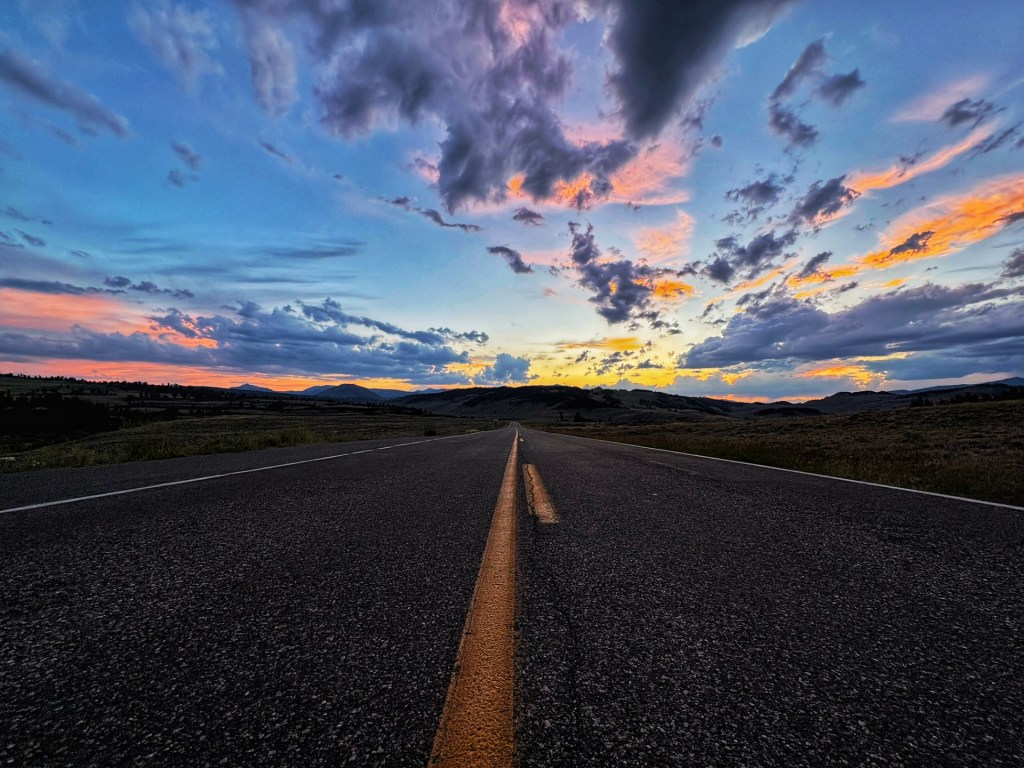
Above: The Road Out. Four days later, I left with more questions than answers— and maybe a little more patience than I arrived with.
If you’re still here, thanks again for reading.
I struggled with my last blog, Glacier, but this one came together much more quickly. The idea was simpler, maybe a little less philosophical, and I think that’s okay. Not every lesson has to be complicated.
Sometimes patience, humility, and a good reality check are enough to create a little personal growth.
I know I can be impatient. I know I like things to go my way, and I know I can be easily frustrated. Those aren’t new revelations, but Yellowstone gave me a few days to sit with them in a different way.
I’m curious if I can be mindful enough to notice them sooner next time those feelings start to fester.
That’s the point, right? Personal growth.
Thanks for hanging out with me.
I’ll see ya on the next one.
Oh…and don’t forget to pray!
Happy trails,
Edward
“We don’t see things as they are, we see them as we are.” — Anaïs Nin


Leave a comment