The Gift of Feeling Small
I study wildlife for a living. I seek out wild places. I love an adventure, and these days I will happily build an entire trip around the possibility of seeing an animal or walking up a mountain, especially since I don’t see mountains as much right now.
The funny thing is, I didn’t really grow up doing any of that.
My family wasn’t taking annual trips out West or loading up the car every summer to visit national parks. I didn’t grow up hiking through the mountains or checking animals off a life list.Places like Glacier existed mostly in photographs and nature documentaries—beautiful, obviously, but also distant from the world I knew. I went camping a few times when I was really young but that exposure to the wild turned into baseball fields and basketball courts.
Somewhere along the way, that changed.
Wildlife became my career. Hiking became something I actively sought out. Mountains became places I wanted to stand beneath rather than look at on a screen. So now, as someone whose life has somehow become increasingly centered around wildlife and wild places, getting the chance to visit Glacier National Park felt like a really big deal.
And I had been looking forward to this one.
Glacier is only about three hours north of Missoula, where I had been spending a couple of weeks working with collaborators on our javelina research. My friend and fellow javelina graduate student, Daniel, and I had a free weekend, a tent, hiking gear, and just enough time to see how much of Glacier we could possibly cram into a couple of days.
Challenge accepted.
More importantly, I was ready to unplug for a few days.
I didn’t even bring my computer. That probably sounds insignificant, but I honestly couldn’t remember the last time I had gone nearly three days without opening it to work. No emails. No checking what needed to be done next. No telling myself I would just knock out one quick thing before getting on with the day.
For a couple of days, whatever was waiting for me could wait.
I didn’t really know it yet, but that little decision to leave my computer behind was the beginning of exactly the reset I needed.
____
The drive north was an adventure in itself.
We traveled through the Flathead Reservation, across the Mission Valley, and eventually alongside Flathead Lake. The Mission Mountains rise sharply to the east, with the lower Salish Mountains to the west, making large stretches of the drive feel like you’re being funneled toward something bigger.
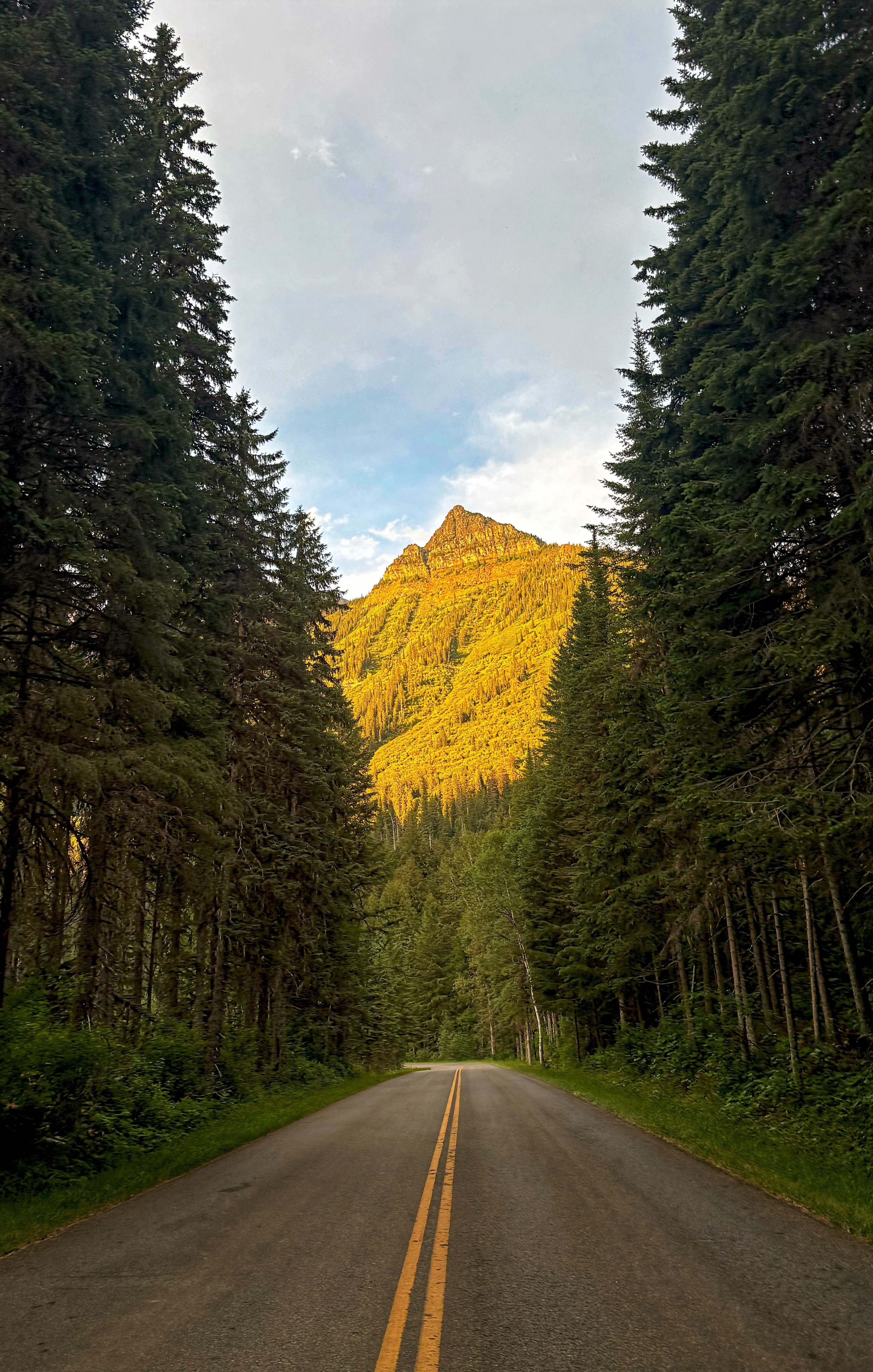
But the closer we got to Glacier, the more the mountains in front of us started to change.
At first they were just shapes on the horizon. Then, mile after mile, they seemed to creep toward us.
The mountains we had already been driving through weren’t exactly small, but these looked different. Steeper. Sharper. Bigger in a way that was difficult to judge from a distance. I couldn’t tell exactly what we were driving toward yet; I could only tell that whatever was ahead seemed to be operating on an entirely different scale.
That feeling kept building until we came through the south entrance and into West Glacier.
Suddenly there were people everywhere. Shops. Restaurants. Tourists walking around carrying bags of huckleberry everything. It had the energy of one of those little towns built around the fact that everybody passing through is excited to be there.
And that’s when it really hit me.
Oh crap. I’m actually in Glacier.
I was excited, obviously, but more than anything I remember feeling grateful. I didn’t know exactly what the next couple of days were going to look like. I didn’t know what animals we would see, how the hikes would feel, or whether Glacier would live up to the version of it I had built in my head.
I was just incredibly happy that I got to find out.
Glacier itself became a national park in 1910, although drawing a park boundary obviously did not begin the human history of this landscape. People had lived in and moved through these mountains for thousands of years before that designation, and the land remains deeply connected to the histories and cultures of the Blackfeet, Salish, Pend d’Oreille, and Kootenai peoples.
We were just two more people passing through.
And we hadn’t made it two minutes before Glacier gave me my first reason to pull over.
Into Glacier
Lake McDonald was the first thing that really got me.
We hadn’t been inside the park long when we rounded the road and there it was—an enormous stretch of impossibly clear blue water with mountains erupting from the opposite shoreline.
I immediately pulled over.
There are places where you have to remind yourself to pay attention.
This was not one of them.
It felt like somebody had turned all of my senses up.
The air seemed crisper. Sounds seemed clearer. Colors looked almost oversaturated. I know saying that my vision suddenly felt like it was in ultra-HD sounds ridiculous, but that’s about the best way I can describe it. Glacier had some of the most vibrant natural colors I had ever seen.
And the water…
I couldn’t get over the water.
Lake McDonald was calm, with just enough breeze moving across the surface to remind you it wasn’t glass. Beneath it, smooth rocks in reds, greens, browns, grays, yellows, and seemingly every shade in between remained perfectly visible through water that looked almost unnaturally clear. It was somewhere in the low 80s, but beneath the trees, with that light mountain breeze moving through, it felt perfect.
For someone who had just deliberately left his computer three hours behind, it was a pretty good introduction to doing absolutely nothing productive.
I wanted to stop everywhere.
That quickly became a recurring problem in Glacier.
Not an actual problem.
More of a we are never going to get anywhere if I pull over every time something looks incredible problem.
As we continued along the lake, the water changed. The calm blue surface eventually gave way to water rushing through rock and forest, and somehow it was still that same ridiculous blue-green color. It reminded me of photographs from Bora Bora or the Maldives—the kind of crystal water you expect around a tropical island.
Except we were nowhere near an ocean.
We were in Montana, surrounded by mountains, watching that water rush beneath enormous trees.
I had been in Glacier for maybe an hour and was already running out of appropriate reactions.
Mostly, I just kept looking.
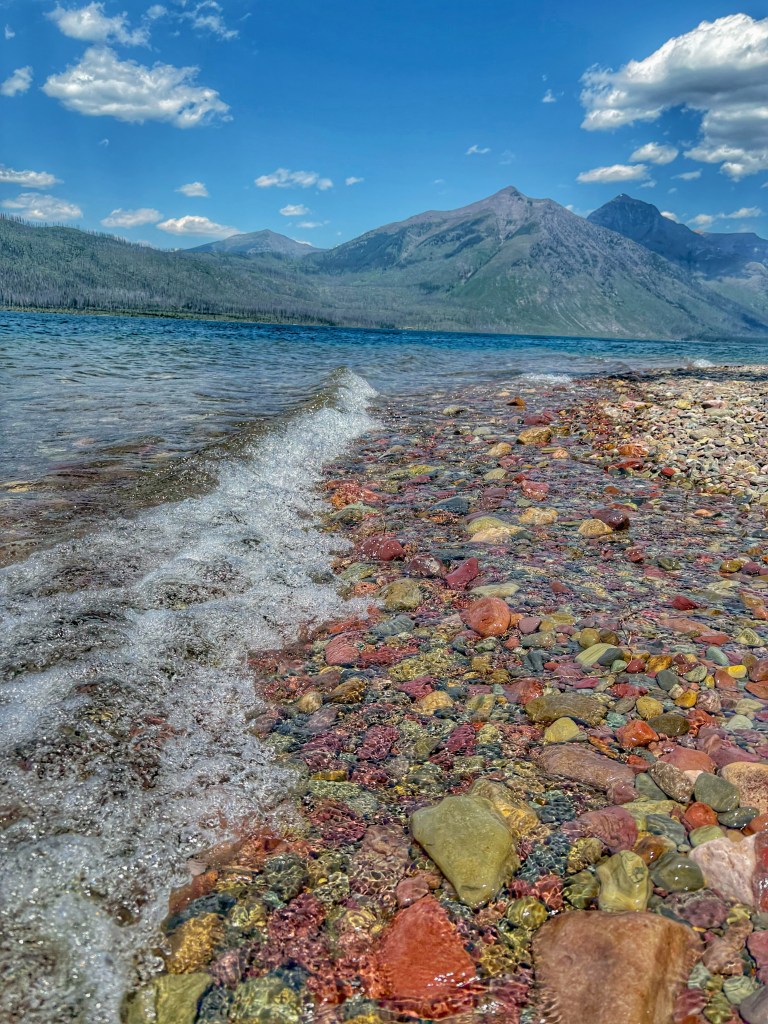
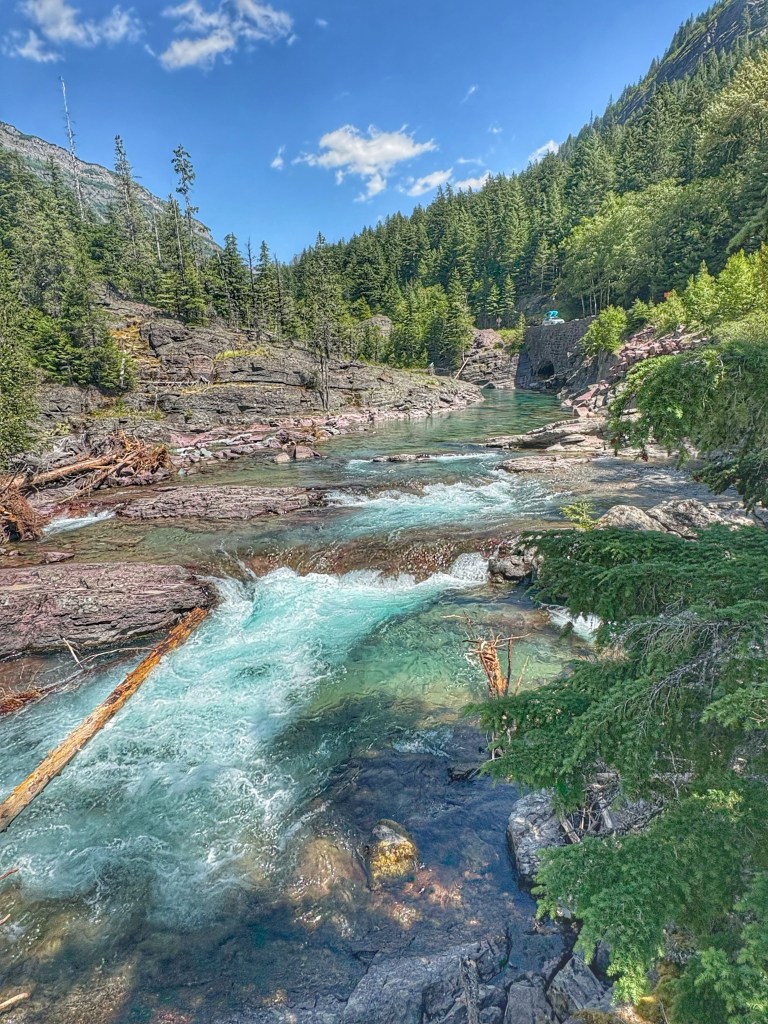
Above Left: Lake McDOnald Above Right. River
Avalanche Lake
Eventually, it was time to stop driving. Our first actual hike in Glacier was Avalanche Lake.
Normally, I am someone who prefers getting away from crowds. If there are two trails and one has 300 cars at the trailhead while the other has three, I am probably wondering what the three-car trail knows that everyone else doesn’t. Part of that is probably just my tendency to want to blaze my own path and question why everyone seems to be doing the same thing.
But that’s another blog.
Avalanche was busy—very busy—but sometimes the beaten path is beaten for a reason. Sometimes it is less of a follow the crowd path and more of a collective “Hey, make sure you don’t miss this” type of trail.
Avalanche Lake is one of those places.
The trail was full of people talking, groups laughing, and kids asking how much farther they had to go. All perfectly reasonable ways to enjoy a hike, but when I hike, I usually prefer quiet. I like hearing my boots hit the trail and listening for birds. I like trying to pick out the sound of water before I can actually see it. Weirdly enough, I even like hearing my own heavy breathing when a trail starts climbing. I notice smells as the vegetation changes, and I am constantly looking at tracks, scat, broken branches, or anything else that tells me something moved through before I did.
When the noise fades, everything else seems to get a little louder.
Avalanche Creek followed portions of the trail, rushing through dark rock that had been polished and carved by water. That same brilliant blue-green color we had seen earlier twisted through the forest beneath enormous trees. Least chipmunks seemed to appear every twenty feet, apparently assigned by the National Park Service to ensure nobody went too long without saying, “Look at that little guy.”
Around seemingly every bend was something worth slowing down for.
That was becoming a theme.
I had arrived in Glacier wanting to squeeze as much as possible into one weekend, but Glacier seemed determined to make me stop every hundred yards and actually look at where I was.
Eventually, after a short 2.3-mile trek, the trail opened onto Avalanche Lake.
Mountains wrapped around the far end of the water like an enormous half-bowl, rising almost vertically from the shoreline. Thin waterfalls dropped from the cliffs in the distance while the cold blue lake stretched quietly beneath them.
I had seen photographs of Avalanche Lake before. Apparently, so had everyone else. But photographs don’t really prepare you for scale.
A photograph has a convenient way of shrinking everything. Mountain, waterfall, lake, and forest can all fit neatly onto the same little screen. Standing there was different. My eyes had to wander across the lake, climb the walls of rock, trace the waterfalls down the cliffs, and then start all over again because there was simply too much landscape to absorb at once.
So we sat down.
We stayed there for probably half an hour, and almost nothing happened. Clouds moved slowly overhead. The lake barely changed. The mountains remained exactly where they had been for a very long time, while a few chipmunks ran around our feet looking suspiciously comfortable around generations of hikers invading their neighborhood.
And somehow, I was completely entertained.
I could have stared at that same view for hours. What struck me was how content I was doing essentially nothing. I wasn’t waiting for something to happen or reaching for the next source of stimulation. I was just sitting beside a lake, looking at mountains.
There was something almost strange about that.
We live in a world where a device in our pocket can provide an endless stream of new videos, messages, information, and distractions, all competing for a little more of our attention. Yet there I was, completely content watching a mountain do absolutely nothing.
For once, I didn’t need anything from the moment. I didn’t need to accomplish something while I was there, document every second of it, or turn the experience into something productive.
I just wanted to sit there long enough to notice it, hoping to burn the image into my memory.
Eventually, daylight reminded us that Glacier was not particularly concerned with our schedule. Our campsite was on the other side of the park, and we still had an entire mountain range to cross.
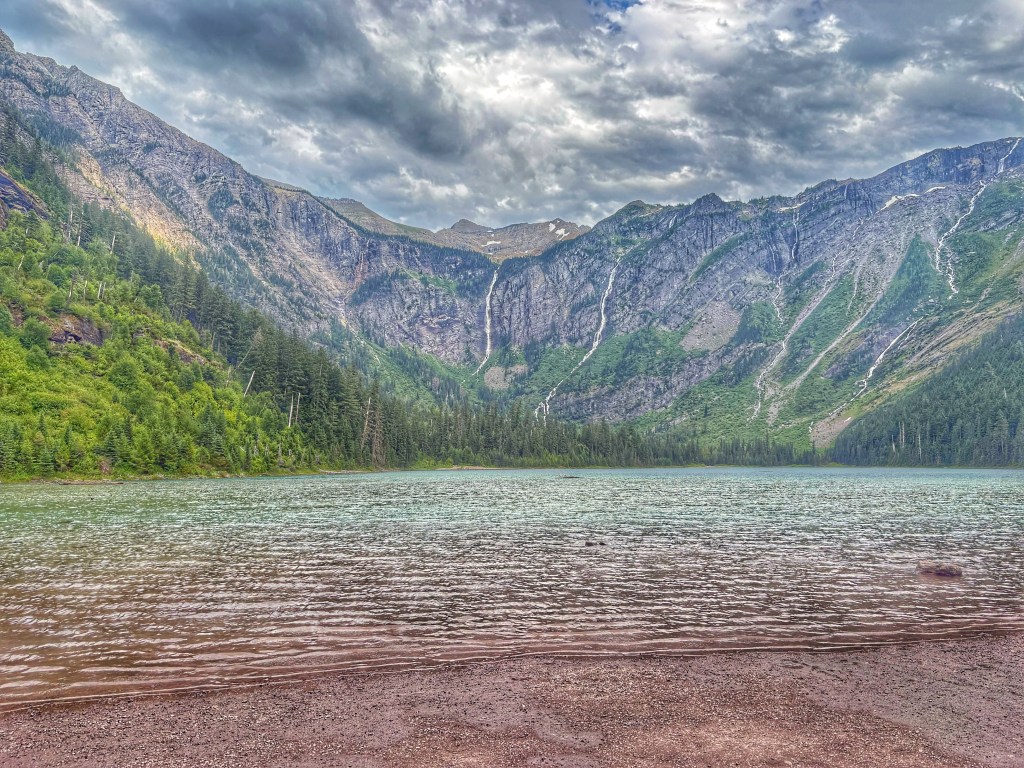
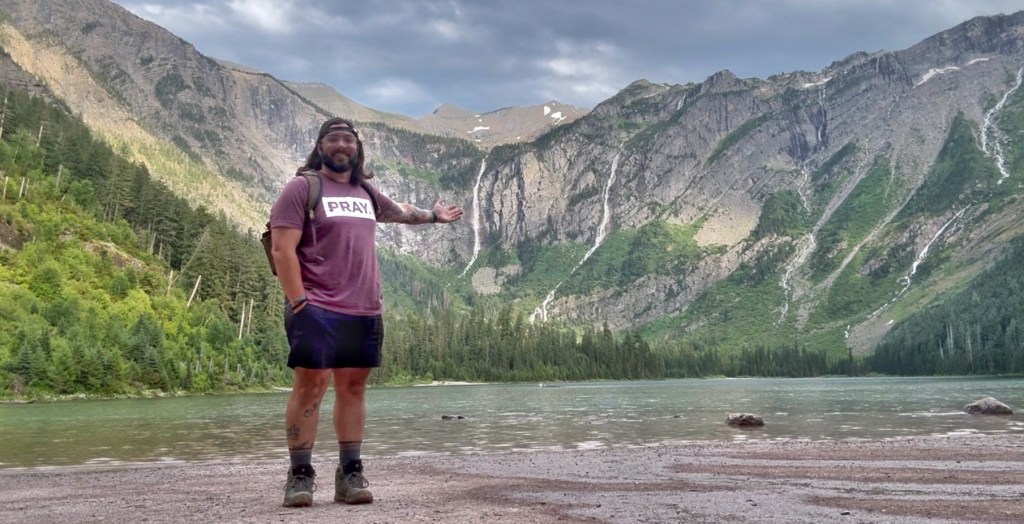
Above: Avalanche Lake. I had seen photographs of this view plenty of times before coming to Glacier, but seeing it in person was different. The trail suddenly opens into this enormous bowl of mountains surrounding a cold blue lake, with waterfalls dropping down the cliffs in the distance. Sometimes a place is photographed a thousand times because everybody who arrives there independently has the same thought: You have to see this.
Going-to-the-Sun Road
From Avalanche Lake, we got back in the car and started making our way across Going-to-the-Sun Road toward St. Mary’s Campsite.
There probably isn’t a more appropriately named road.
As we climbed, the landscape changed almost continuously. The forest began to thin, the slopes grew steeper, and the mountains became more exposed and rugged. Every switchback seemed to rearrange the entire view. One minute the sun was directly in front of us, glowing between the peaks, and a few turns later it was behind us, lighting up the mountains we had just crossed.
I remember thinking that this had to be why they called it Going-to-the-Sun Road. It felt like we were winding our way toward the light, then turning away from it, only to meet it again around the next bend.
The higher we climbed, the more dramatic everything became.
The valleys dropped farther below us. The peaks seemed to rise higher above the road. What had looked enormous from Lake McDonald now surrounded us on every side, and the landscape became increasingly rugged as we worked our way toward Logan Pass.
It was incredible.
It was also a little nerve-racking.
I am not particularly ashamed to admit that some of those cliffs made me nervous. There were stretches where Daniel got to enjoy the sweeping views while I focused very intently on the road in front of me. Every so often I would risk a quick glance out toward the valley, immediately remember how far down it went, and decide that staring straight ahead was probably the wiser choice.
Whenever we found a place to pull over, though, I was out of the car.
The road itself almost forced you to keep recalibrating your sense of scale. From inside the vehicle, a mountain might look like one enormous wall of rock. Then we would stop, step outside, and realize that the road we had just driven was only a thin line cut into the side of something vastly larger.
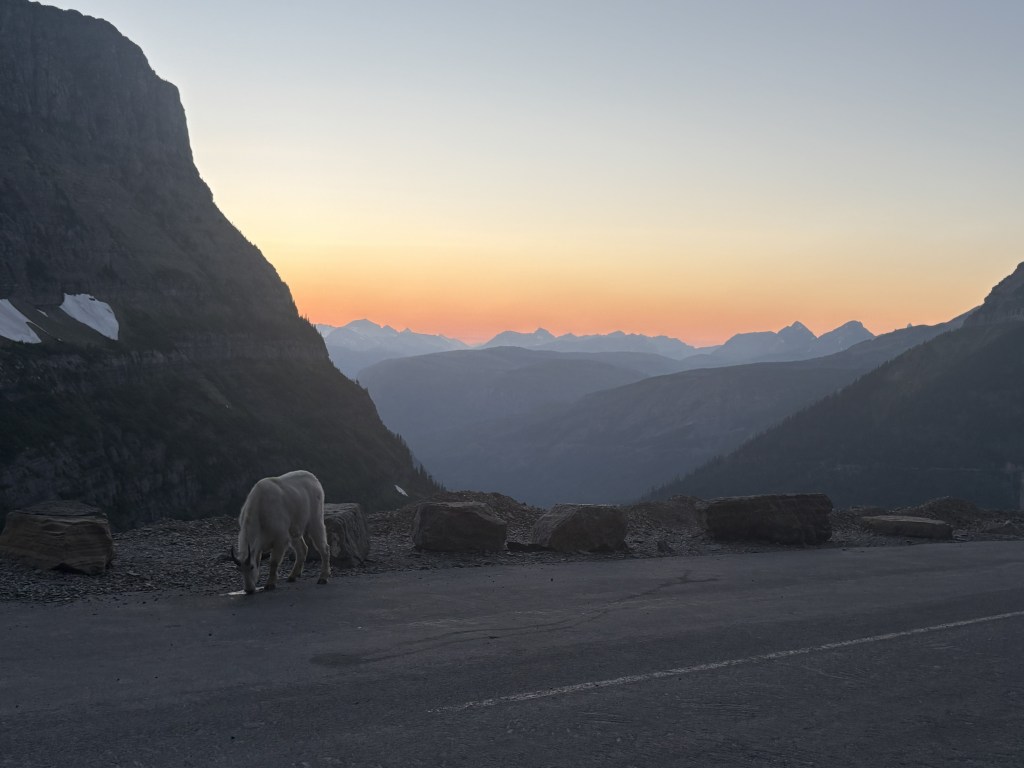
Somewhere near Logan Pass, I spotted something white on the mountainside.
A mountain goat.
My first one.
I had come to Glacier hoping to see mountain goats, so there was no pretending I was casual about it. I was ridiculously excited. We stopped, watched it move across the slope, and I remember being struck by how completely at home it looked in a place that still felt almost unreal to me.
For the goat, none of this was remarkable. It wasn’t a national park, a scenic drive, or some once-in-a-lifetime experience.
It was just home.
That thought stayed with me as we continued east.
By then, the sun had dropped lower in the sky and the light across the mountains had started to soften. The same peaks that had looked sharp and imposing earlier were now glowing in the evening light, and every turn continued to reveal another view worth stopping for.
The only problem was that we still had to set up camp before the night completely disappeared.
The responsible decision would have been to keep driving.
We were not particularly good at that.
And I don’t regret it.
Back to Camp
By the time we reached St. Mary’s campsite, it was already dark.
That made setting up camp a little more interesting, but honestly, I didn’t mind. It had been a long time since I had camped this simply—just a tent, sleeping pad, sleeping bag, a fire, and whatever food we had brought with us.
No cabin. No hotel. No electricity. No real comforts beyond what we carried in.
And I had missed that.
There is something about camping that strips life back down to the basics. You stop thinking about what room you are in, what you should be doing next, or what needs your attention tomorrow. Instead, you think about where the tent should go, whether the fire is catching, what you are going to eat, and how cold it might get overnight.
After a day of constantly looking outward at mountains, lakes, cliffs, wildlife, and everything else Glacier had thrown at us, it felt good to end the night with something simple.
We got the tent up, started a fire, and cooked dinner.
The campground had mostly quieted down by then. Somewhere nearby, we could hear the river moving through the darkness. Above us, the sky was full of stars, and without the usual glow of a town or city nearby, the darkness actually felt dark.
I remember sitting around the fire and thinking about how little I needed in that moment.
Food. A place to sleep. A fire. And to reflect on the day.
That was pretty much it.
For someone who had arrived needing a reset, there was something almost comforting about how uncomplicated the night felt.
Eventually, we crawled into the tent.
I wish I could say I slept like a rock after hiking, driving, and taking in some of Glacier.
I absolutely did not.
Physically, I wasn’t exhausted at all. If anything, I was wired. My mind kept replaying the day—the lake, the blue-green water, Avalanche, the cliffs, the sunset, the mountain goat near Logan Pass. There had been so much to take in that my brain apparently had no interest in shutting any of it off just because I had zipped myself into a sleeping bag.
The sleeping pad didn’t exactly help either.
I spent most of the night rotating between whichever shoulder, hip, or part of my back was least annoyed with me at the time.
But even lying there awake, I remember being happy.
The river was still moving somewhere beyond the tent. The mountains were out there in the darkness even though I couldn’t see them anymore. The fire had gone quiet, the campground had settled, and for the first time in a long time, there was absolutely nothing I could do about work even if I wanted to.
My computer was hours away.
My emails could wait.
Everything could wait.
I had forgotten how good that could feel.
That may have been one of the things I missed most about camping—not just sleeping outside, but the way it forces you to live inside the day you are actually in. There is less room for everything else to crowd in.
Even without much sleep, I felt more rested than I had in a while.
Not physically.
Mentally.
And by the time morning came, I was ready to see what Glacier had waiting for us next.
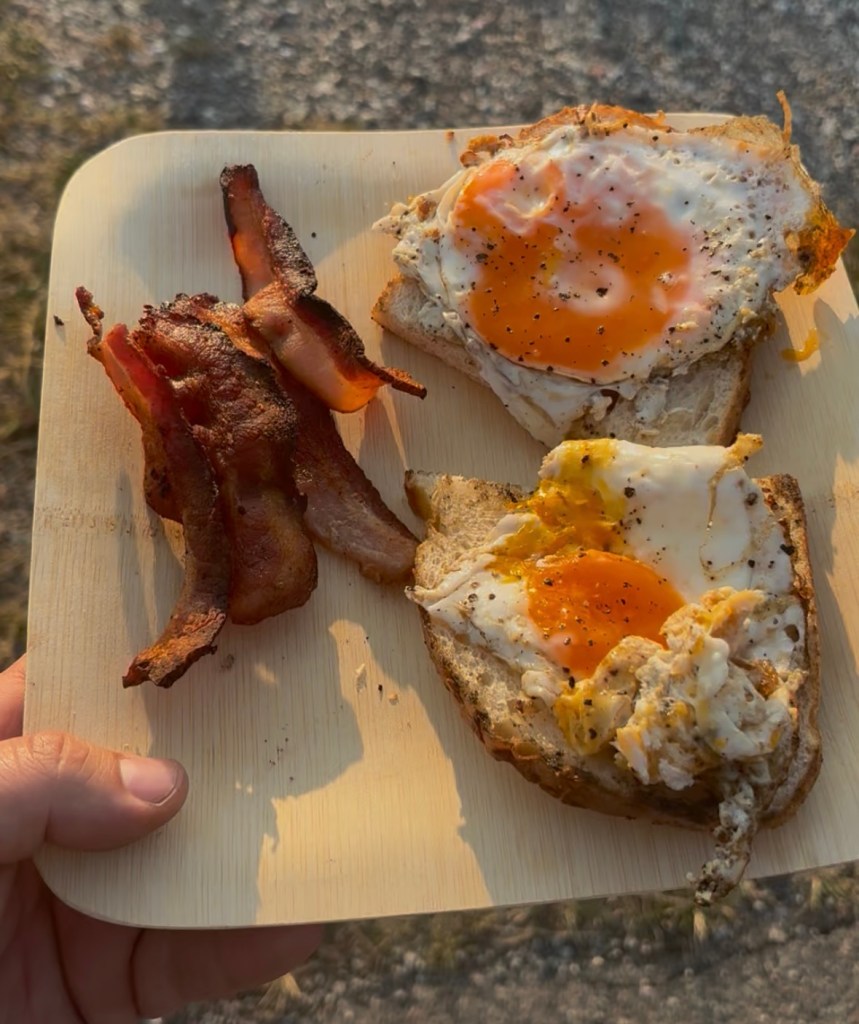
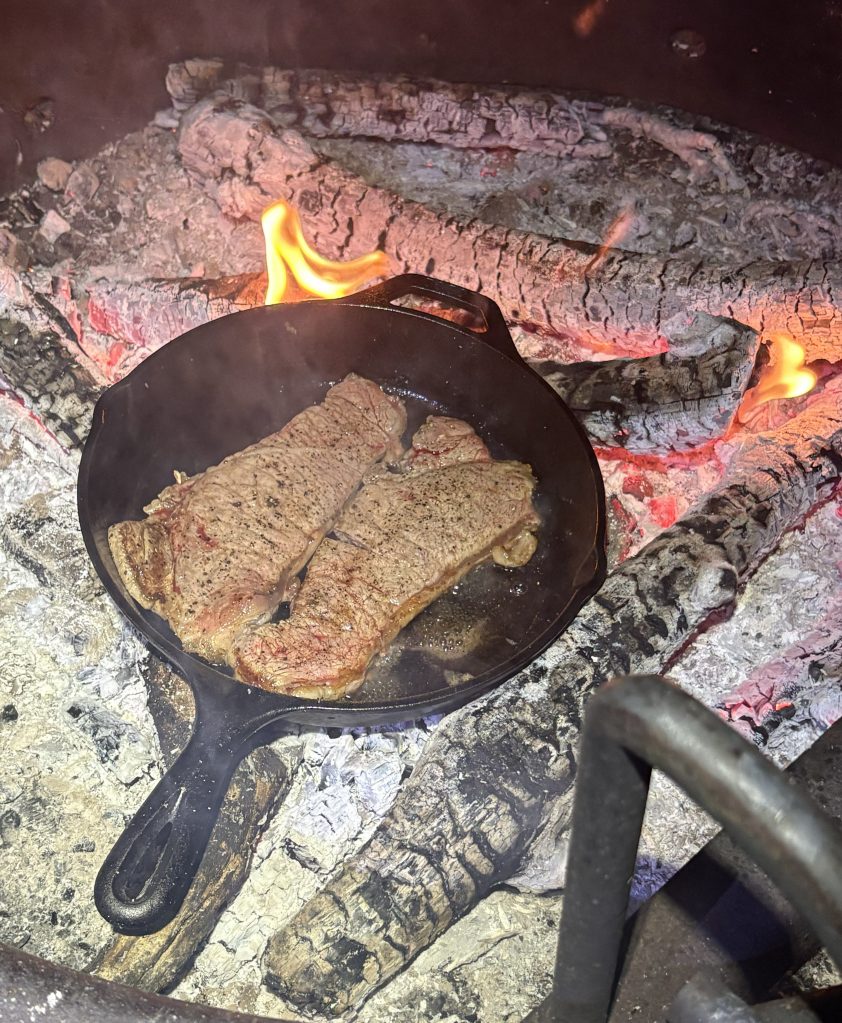
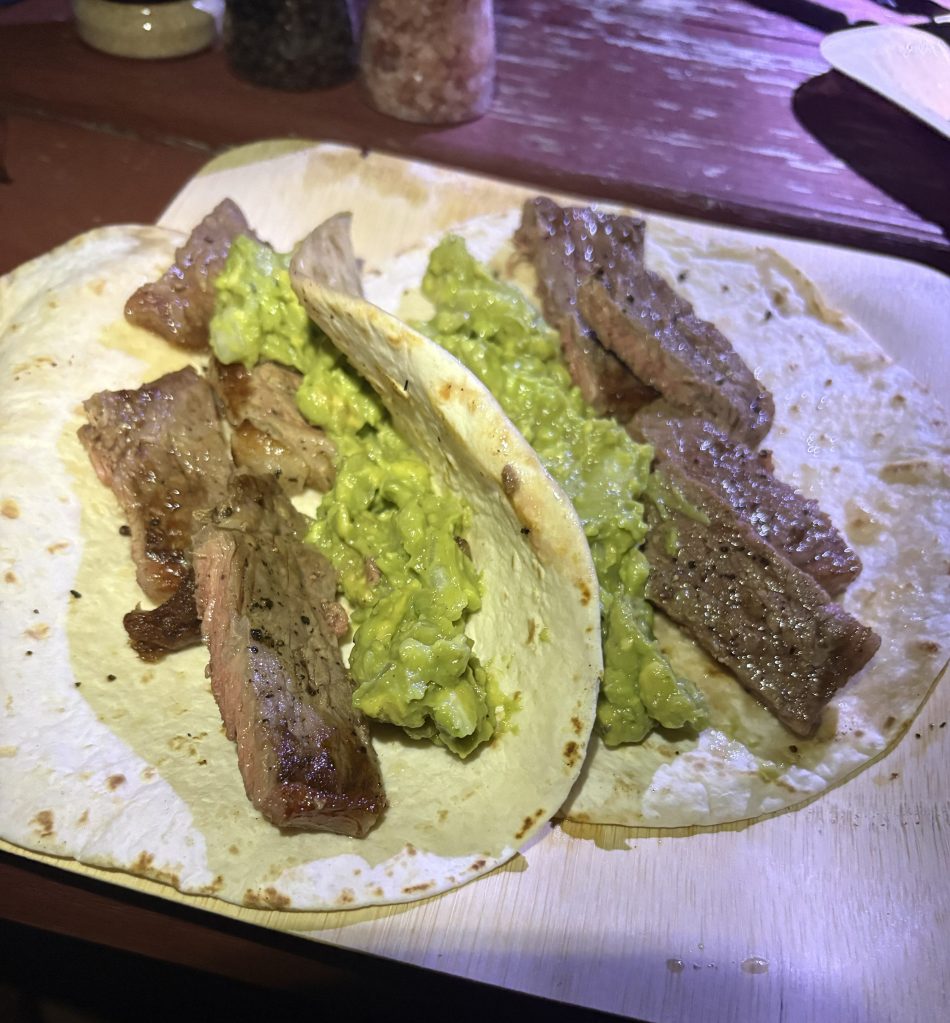
Above: Camp food: bacon and eggs in the morning, steaks over the fire, and eventually steak tacos. Everything tastes better when cooked on the campfire. I don’t make the rules.
Grinnell Glacier
Saturday morning started the way a camping morning should: with breakfast over a fire and absolutely no desire to rush.
We packed water, snacks, the camera, binoculars, bear spray, and everything else we thought we might need for the day before heading toward Grinnell Glacier. This was the hike I had probably been looking forward to most.
The trail to Grinnell Glacier is roughly five miles each way, climbing about 1,600 feet before reaching the glacier basin. Relativly mild in a hiking sense. We also had plans to add Grinnell Lake on the way back, which would tack on another five miles or so.
By the end of the day, we would be somewhere around fifteen miles, which may seem like a lot, but when excitement and endorphins are flowing, it feels like child’s play. A 1,600-foot climb is also modest.
At the trailhead, though, that was still just a number.
The first few miles moved through forest and along those impossibly colored glacial lakes that Glacier seemed to have no shortage of. The trail gradually gained elevation, and with each stretch of climbing, the landscape opened a little more.
What I remember most is how often the scenery changed.
We would move through shaded forest, then suddenly step into an open mountainside where the entire valley stretched out beneath us. Around another bend, a waterfall would appear pouring down from somewhere high above the trail. In a few places, water coming off the mountain actually crossed our path, spilling over rock and continuing downhill toward the lakes below.
There is something different about walking through a landscape instead of simply looking at it.
From a road, the mountains are scenery. They sit beyond the windshield and disappear behind you as you drive.
On Grinnell, we were physically moving through them.
We could hear water before we saw it. We could feel the temperature change in the shade. The trail narrowed in places where the mountain rose steeply on one side and dropped away on the other. When the wind moved across the exposed slopes, you felt it differently than you did down near the lake.
And then there were the wildflowers.
I knew Glacier would have mountains, wildlife, and glaciers. I had not expected the wildflowers to become one of the things I remembered most.
Entire sections of the mountainside were covered in them.
Purples, yellows, whites, reds, and colors I probably couldn’t identify even if you gave me a field guide. Some grew in thick patches along the trail while others covered open meadows beneath enormous walls of rock.
It was one of those strange contrasts Glacier seemed to produce constantly: these massive, rugged mountains rising above us while tiny flowers covered the ground at our feet.
I kept catching myself looking in both directions.
Up at the mountains.
Then down at the flowers.
The farther we climbed, the easier it became to understand why people talk about Glacier as if it were a different world.
—
At one point, while hiking high above the lake, I noticed a moose down in the water below us.
That obviously required a stop.
We were already far enough above the lake that the moose looked surprisingly small from where we stood, even though there is nothing small about a moose. I pulled out the binoculars and camera and spent some time watching it move through the water.
This was exactly why I had carried both all the way up the trail.
There were plenty of people hiking Grinnell that day, but moments like this still felt earned. You had to put in the miles, climb above the lake, keep your eyes open, and actually pay attention to what was happening far below you.
The moose was just going about its day while dozens of us slowly worked our way up the side of the mountain.
We stopped for a while, admired it, took some pictures, and then eventually kept climbing.
Ahead of us, the trail continued across waterfalls, through wildflower-covered slopes, and along narrow sections cut into the mountainside as we worked our way higher toward the glacier.
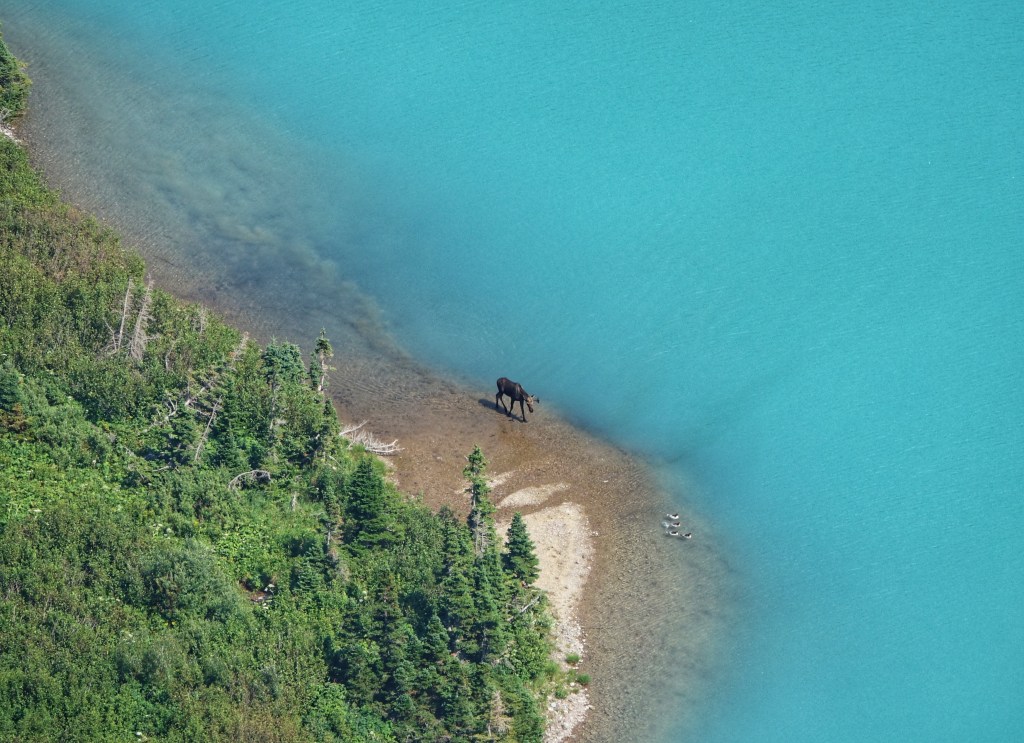
Above: One of those moments where carrying binoculars and a telephoto lens pays off. We were well above the lake when I noticed this moose down below. Glacier has a way of rewarding you for slowing down and actually looking.
The trail continued climbing.
And climbing.
And then, for good measure, climbing some more.
Every so often, we would round a bend, see what looked like the top, and convince ourselves that surely we had to be close.
We were not.
Then another climb would appear.
Another switchback.
Another stretch cut into the side of the mountain.
At some point, the trail became less about wondering how far we had left and more about accepting that we would get there whenever the mountain decided we had earned it. The trail wasn’t a crazy long hike, the incline wasn’t brutal, but the switchbacks played with your head a bit. You would get closer, just to turn around and get further away. A natural mind game if you will.
The landscape was becoming increasingly alpine as we went. Trees became fewer and farther between, exposed rock became more common, and the trail felt smaller against the surrounding mountains.
Then, eventually, the basin opened in front of us.
Grinnell Glacier.
After miles of climbing toward it, finally seeing the glacier up close felt completely different from seeing it from a distance.
It was no longer something sitting high on a mountain.
We had climbed into the landscape that held it.
We stayed up there for a while.
That part matters to me because Grinnell was not simply a destination where we reached the end of the trail, took a picture, and immediately turned around.
We explored.
We found a place to sit and eat lunch. We wandered around the basin. We watched meltwater move through the rocks and took in the ice, water, and mountains surrounding us.
After spending hours looking up at these mountains, suddenly we were sitting among them.
I remember filtering water coming directly off the glacier and drinking it there.
I still maintain that it was the best water I have ever tasted.
My aunt and uncle’s house water remains a very respectable second place.
Maybe glacier water actually tastes better.
Maybe everything tastes better after hiking in a euphoric state of mind.
Either way, I am sticking with the story that glacier water is pinnacle.
While we were sitting there, a mountain goat began making its way across the glacier.
Watching it move across the ice was one of my favorite moments of the entire weekend.
The night before, I had been ridiculously excited just to see my first mountain goat near Logan Pass. Now I was watching one cross a glacier as casually as if it were walking across someone’s backyard.
For the goat, none of it was extraordinary.
This wasn’t a national park.
It wasn’t a bucket-list destination.
It was simply home.
That thought made the place feel even larger somehow.
Not physically larger.
Larger than my experience of it.
We had arrived that morning, would spend a few hours there, and then leave. The goat would remain. Other animals had moved through that basin long before us. Water had been carving its way down the mountain long before there was a trail. Ice had shaped the valley over spans of time that were almost impossible to comprehend.
Standing near a glacier makes time feel different.
In everyday life, time is measured in hours, deadlines, semesters, meetings, birthdays, and years.
Up there, those measurements suddenly felt very small.
The mountains had been changing long before I existed. The glacier had advanced and retreated over time. Water continued to wear away at rock. Entire valleys had been shaped by processes that unfolded across timescales far beyond a human life.
We often think of mountains as permanent.
But even they are changing.
Just much more slowly than we are used to noticing.
That stayed with me while we sat there.
The place looked still, but it wasn’t.
Nothing really is.
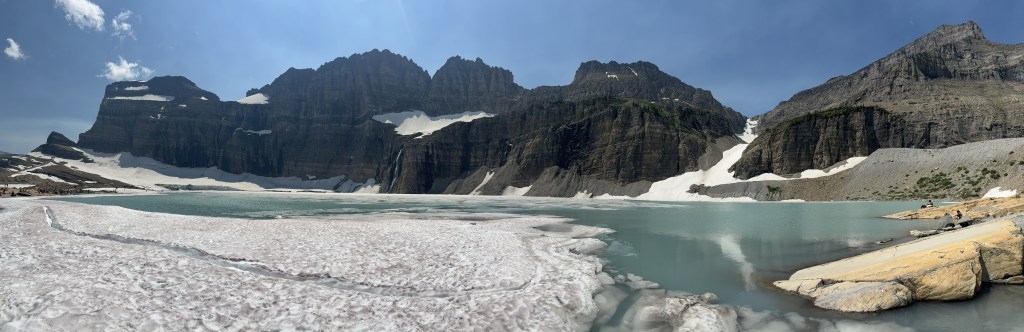
Above: Grinnell Glacier. About six miles of hiking brought us here, and suddenly sore shoulders seemed like a pretty reasonable admission price. Grinnell is one of the park’s best-known glaciers and has changed substantially over time; NPS measurements show it lost about 45% of its area between 1966 and 2015.
Earned Tired
Eventually, we had to start making our way back down from the glacier.
The descent gave us the same landscape we had spent the morning climbing through, but from a completely different angle. Places that had seemed impossibly far below us slowly rose to meet us again. The glacier disappeared behind the mountains, the exposed slopes gave way to more trees, and the lakes that had looked small from high above began to take over the view again.
By the time we reached the bottom of the Grinnell Glacier trail, we had already covered about ten miles.
Some people probably would have called that a day.
But there was more to see.
At the trail junction, we took the other side of the fork toward Grinnell Lake.
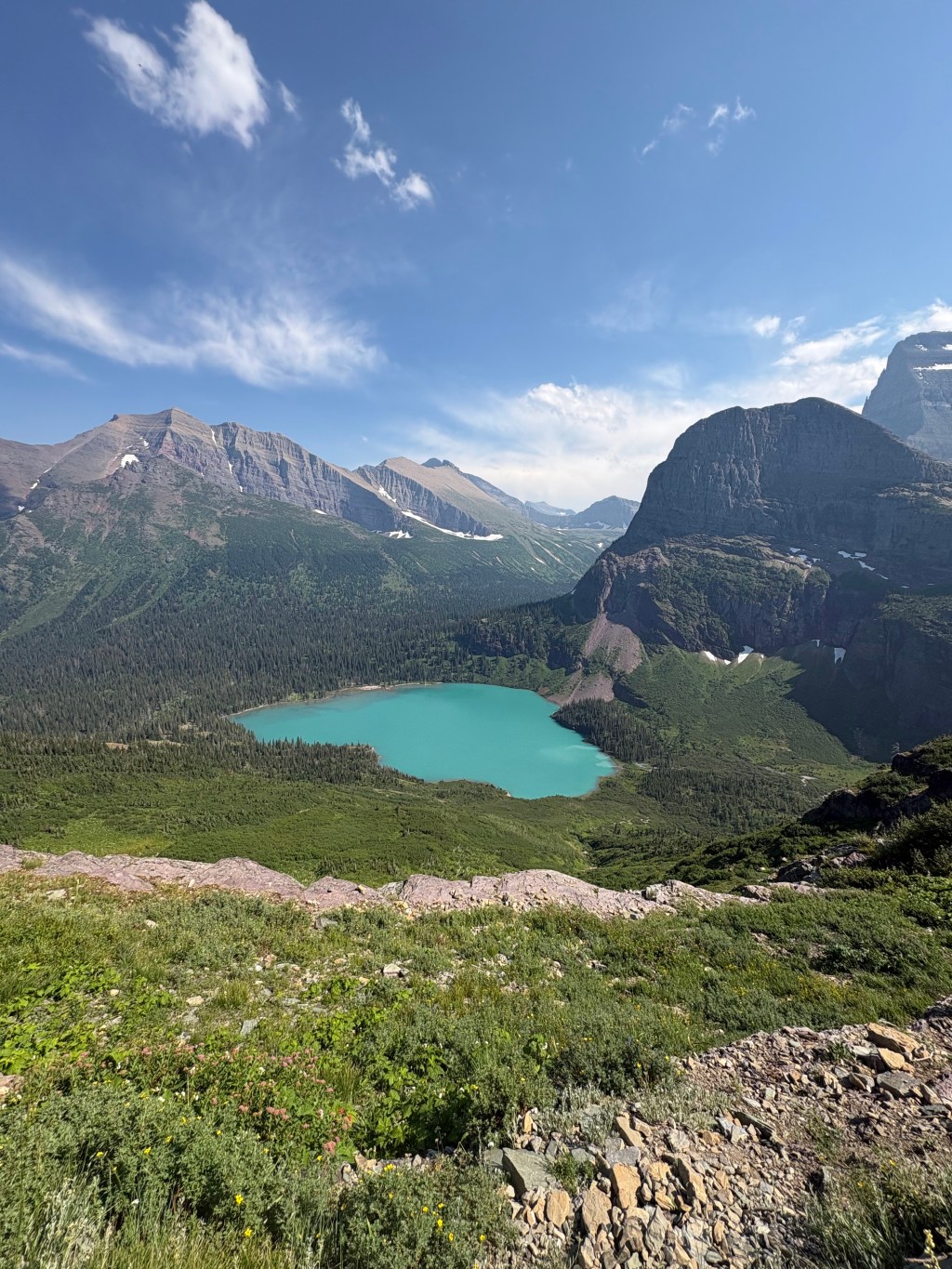
We had wanted to do both from the beginning. Part of what made the day so appealing was the chance to experience the same landscape from two completely different perspectives. Earlier, we had looked down on Grinnell Lake from thousands of feet above the valley, watching it sit beneath us like a small blue piece of the landscape.
Now we wanted to stand beside it and look back up at everything we had just climbed.
The trail to the lake was much quieter than the one to the glacier. After spending most of the day around other hikers, that change was immediately noticeable. The noise faded, the pace slowed, and before long we were standing beside another one of Glacier’s almost unreal blue lakes.
The water had that same brilliant color I still did not quite know how to describe, and the shoreline was covered with smooth, colorful rocks visible beneath the clear water.
But the view was completely different now.
Instead of looking down into the valley, we were standing inside it.
The mountains rose around us, and somewhere high above was the trail we had spent the day climbing. I remember looking up toward it and trying to trace where we had been just a few hours earlier.
From above, the lake had looked small.
From the shoreline, the mountains did.
Or maybe we did.
I wanted badly to set up my hammock, crawl in, and drift off for a couple of hours beside the water. It was quiet enough, cool enough, and peaceful enough that I probably could have fallen asleep almost immediately.
Unfortunately, we still had miles to go and not nearly enough daylight to justify pretending we had nowhere else to be.
So we stayed for a while, took in the lake from this completely different viewpoint, and eventually started back toward the trailhead.
By the time we finished, we had covered roughly fifteen miles.
My shoulders hurt from the pack. My legs were tired. Every little incline near the end felt much steeper than it probably was.
But it was the good kind of tired.
Earned tired.
The kind that comes from knowing your body spent the entire day carrying you somewhere worth going. Although also incredibly humbling, as I had not been hiking like this in a depressing amout of time.
—
An Earned Kind of Tired
By the time we made it back, neither of us had much interest in doing anything complicated for dinner.
We stopped at the little mountain store, grabbed something to eat and a couple of beers, and headed back toward camp as the sun started dropping behind the mountains.
There was no big plan for the evening. No more trails to squeeze in. No need to make the most of another hour of daylight.
We had already done enough.
So we ate, cracked open a beer, and watched the last light move across the mountains.
After roughly fifteen miles of hiking, my legs were tired, my shoulders were sore, and sitting still felt better than just about anything else could have.
It was that same kind of exhaustion I had felt at the end of other long days outside—not drained in a way that made me miserable, but tired in a way that felt earned.
The kind of tired that makes food taste better, a cold beer feel colder, and a sunset seem like more than enough entertainment for the night.
We mostly just sat there and watched the light fade.
And after everything we had seen that day, that felt like exactly the right way to end it.
One More Trail
By Sunday morning, the responsible thing to do probably would have been to pack up and start heading back toward Missoula.
Naturally, we decided there was time for one more trail.
We stopped at Logan Pass and headed toward Hidden Lake Overlook. Compared with the day before, it was a much shorter hike—just over a mile each way—but again, it was one of those paths that said “everyone is doing this for a reason”.
The trail was busy, but the scenery made it easy to understand why.
Wildflowers covered the open meadows, patches of snow still clung to the mountains, and Hidden Lake eventually appeared below us, tucked into another one of those landscapes that somehow looked too perfectly arranged to be real.
And then there were the mountain goats.
They seemed to be everywhere.
By that point, I had already seen my first goat near Logan Pass and watched another crossing Grinnell Glacier, but I was still just as excited every time one appeared. Maybe more excited.
At one point, I noticed a goat moving across the meadow and positioned myself farther ahead along the direction it seemed to be traveling. Then I stayed put and waited.
Sure enough, it kept coming.
Closer.
And closer.
Eventually it walked right past me.
I did not need much convincing to take a ridiculous number of pictures.
My favorite came when one of the goats stood among the wildflowers with the mountains rising behind it. It was one of those moments where everything I had hoped to see in Glacier seemed to come together in a single frame.
The wildlife around Logan Pass also included plenty of the little guys—marmots, ground squirrels, and chipmunks moving through the rocks and meadows while everyone else was busy staring at the goats and mountains.
I probably could have stayed there much longer.
But eventually, there really was no avoiding it.
We had to leave.
So we started back toward the car, took one last look across the mountains, and began the drive south.
Three days earlier, I had entered Glacier wanting to get away from work for a while.
I was leaving with much more than that.
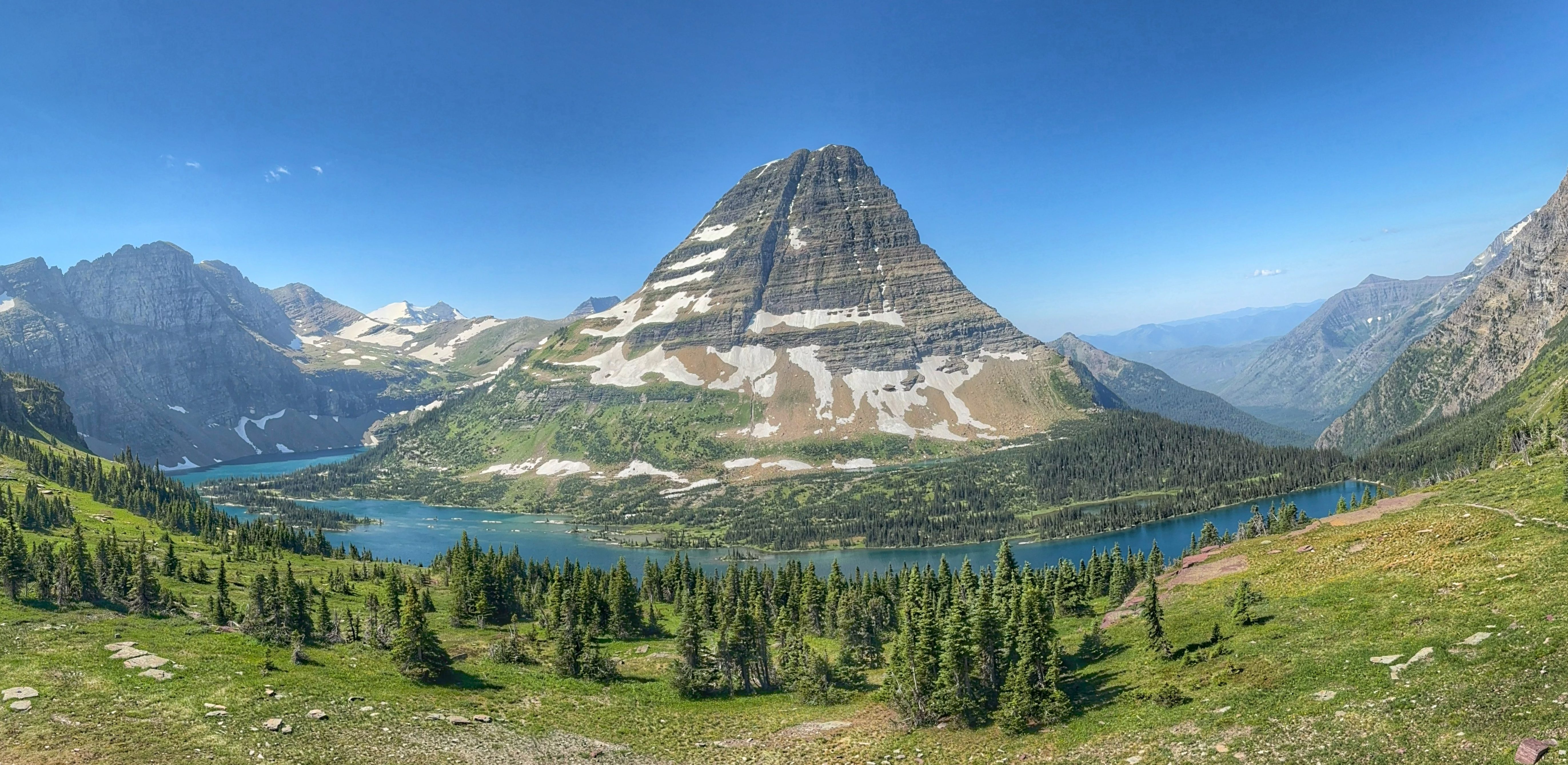
Above: Hidden Lake from near Logan Pass. Another heavily traveled trail. Another view that immediately explains why.
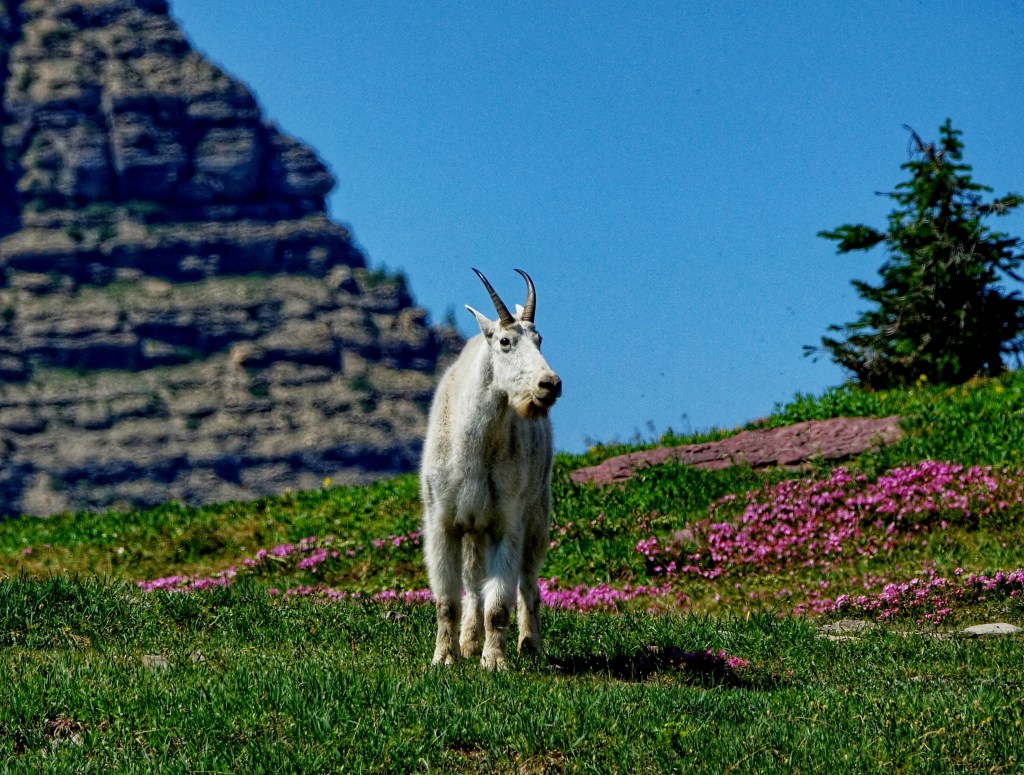
Above: Yeah…come on. A mountain goat standing in a meadow of wildflowers beneath the mountains? If Snow White had walked into the frame, I honestly don’t think I would have questioned it.
Beyond What Feels Real
There were moments in Glacier when the landscape almost didn’t make sense to me.
Snow still clung to high peaks in the middle of summer. Turquoise lakes sat beneath enormous walls of rock. Water was clear enough to see every colorful stone beneath the surface. Wildflowers covered entire mountainsides, waterfalls spilled across our path, and animals seemed to appear exactly where you would put them if you were designing the scene yourself.
At Hidden Lake, surrounded by wildflowers, mountain goats, marmots, and mountains, I joked that I half expected Snow White to come walking out of the trees, singing to the critters.
But underneath the joke was a real feeling.
The place was so beautiful that it almost looked unreal.
I’ve always found that word interesting because we use it constantly when we encounter something extraordinary. That view was unreal. Those mountains don’t look real. It looks like a painting.
But Glacier was completely real.
Maybe the problem wasn’t that the landscape looked fictional. Maybe I just wasn’t accustomed to seeing reality expressed on that kind of scale.
No architect positioned those mountains behind the lakes. Nobody selected the colors of the rocks beneath the water or planted the wildflowers where they would photograph best. Nobody placed a mountain goat against the glacier at exactly the right moment. (no one human that is)
It was simply there.
And for a couple of days, I was fortunate enough to move through it.
That thought brought me back to something I had been thinking about only a few days earlier in Missoula.
I spent a lot of time sitting beside the Clark Fork River there, watching the water move. I remember thinking that the exact version of the river in front of me existed for only an instant. Every ripple, current, reflection, and patch of light formed a combination that had never existed before and would never exist in exactly the same way again.
For that brief moment, I felt like the permanent thing watching something fleeting pass in front of me.
Glacier reversed the roles.
The mountains stood around me. Valleys stretched beneath them. Water continued working its way down from snow and ice. Animals moved across trails and meadows without any concern for the fact that I had traveled hundreds of miles to see them.
And I passed through for a weekend.
On the scale of Glacier’s existence, my entire visit wasn’t much different from one of those ripples in the Clark Fork. I arrived, occupied that landscape for a brief moment, and moved on.
Decades from now, someone may stand beside the same lake or beneath the same mountain and feel the same sense of awe I did. My weekend will be long gone.
There is something humbling about that.
But there is also something beautiful about it.
In Missoula, the fleeting nature of the river made that individual moment feel more valuable because I knew I could never experience that exact version of it again. Maybe my time in Glacier works the same way. Its brevity doesn’t make it meaningless. Its brevity is part of what makes it precious.
The river and I simply traded places.
In Missoula, I watched something temporary pass through a landscape.
In Glacier, I was the temporary thing passing through.
And somewhere in realizing that, the feeling of being small started to make sense.
The Gift of Feeling Small
I firmly believe every landscape has beauty if you’re willing to learn how to see it. I’ve spent enough time studying in the South Texas brush country to know that beauty doesn’t always announce itself with snow-covered mountains, turquoise lakes, and waterfalls.
Sometimes you have to slow down. You have to pay attention long enough for a place to reveal itself.
Glacier did not make me work particularly hard.
There were moments when I would look around and have one simple thought:
God spent extra time on this one.
There are certain places where I feel particularly close to God. Mountains do it. The ocean does it. Large forests do it. Wild places where human noise becomes quieter and creation becomes difficult to ignore.
Maybe part of that is beauty.
But I think part of it is scale.
Glacier made me feel small.
And I needed that.
I had arrived wanting a reset. I left my computer behind because I didn’t want to think about emails, deadlines, research, or the endless list of things waiting for me when I got back. What I didn’t realize was that the reset I needed wasn’t simply a break from work.
I needed a break from myself.
That sounds harsher than I mean it.
But modern life makes it incredibly easy to become the center of our own little universe. I spend an enormous amount of time thinking about what I need to accomplish, what problems I need to solve, where my career is going, what I haven’t finished yet, what someone thinks about me, or what comes next on my list.
My problems feel enormous because I am standing so close to them.
My accomplishments can feel enormous for the same reason.
Then I stand beneath a mountain.
Suddenly, everything gets resized.
A full-grown moose can look tiny from high above a valley. A person can become almost invisible against the side of a mountain. An entire weekend becomes a moment within a landscape shaped across spans of time my mind can barely comprehend.
And strangely, none of that made me feel insignificant.
It made me feel relieved.
There is an important difference between believing I don’t matter and realizing everything doesn’t have to revolve around me for my life to matter.
Maybe that is part of what humility actually is.
We sometimes talk about humility as though it means thinking less of ourselves, diminishing our value, or pretending we are unimportant. But I wonder if humility is better understood as proper proportion—seeing ourselves accurately within something much larger than ourselves.
Faith makes that distinction especially important to me.
Christianity does not tell me that I am meaningless because I am small. Quite the opposite. Human beings are made in the image of God. That gives human life an extraordinary dignity and significance.
But being made in God’s image does not mean being God.
I am valuable.
I am loved.
I have purpose.
And I am still not the center of creation.
Those truths don’t contradict each other. Maybe they actually depend on each other.
Standing beneath those mountains reminded me that I don’t need to make myself bigger in order to matter. I don’t have to inflate every worry until it fills the horizon, or measure my worth by accomplishments, recognition, productivity, or how much I can squeeze into a day.
I can be small and still matter deeply.
Maybe that is the gift.
For a couple of days, Glacier pulled my attention away from the little universe that constantly forms inside my own head and reminded me that I am part of something much larger. I could sit beside a lake without needing it to entertain me. I could watch a mountain goat cross a glacier without the animal knowing or caring that I was there. I could look across a valley and realize that the world continued far beyond whatever happened to be worrying me that week.
My problems didn’t disappear.
My responsibilities were still waiting when I got back.
But they returned to their proper size.
So did I.
And there was something deeply peaceful about that.
Beautiful, Ancient, and Changing
There was one more piece of that perspective that Glacier made difficult to ignore.
The mountains look permanent.
Standing beneath them, it is easy to imagine that they have always looked exactly as they do now and always will. Compared with the pace of a human life, they practically seem frozen in time.
But they aren’t.
Ice moves. Water cuts through rock. Snow melts and returns. Forests burn and regrow. Animals move across valleys. Rock breaks away from mountainsides. Glaciers advance and retreat. Even the things that appear most permanent are constantly becoming something slightly different.
Grinnell made that especially tangible.
Sitting near the glacier, surrounded by a landscape shaped by ice over timescales far beyond my own life, I kept thinking about how strange our sense of time really is. Most of my life is organized around hours, weeks, semesters, deadlines, field seasons, and years. Even a decade feels substantial when you are living through it.
A mountain operates on a different clock.
That doesn’t make human time unimportant. If anything, I think it makes it more valuable.
That was the same lesson the Clark Fork had given me from the opposite direction. The river showed me how precious a moment can become because it disappears almost immediately. Glacier showed me how precious my own moment might be for exactly the same reason.
I am here for an incredibly short time.
So are all of us.
And maybe recognizing our proper proportion within creation should do more than make us humble. Maybe it should change how we treat the brief piece of it entrusted to us.
We did not create these mountains. We cannot claim any meaningful ownership over processes that began long before us and will continue long after us. We are simply the people fortunate enough to be here right now.
That feels less like ownership and more like stewardship.
Maybe our relationship with wild places was never supposed to be about conquering them. Maybe we are supposed to enter them with enough humility to experience them, learn from them, care for them, and then step aside.
We are temporary.
That doesn’t mean our presence is meaningless.
It means what we do with our moment matters.
And maybe, if we do it well, generations from now someone else will be able to stand beneath those same mountains, look up, and receive the same wonderful reminder:
You are incredibly small.
You are not the center of all of this.
And you still matter.
Questions I’m Carrying With Me
Why is the water in Glacier that almost unbelievable shade of blue and turquoise? – This one I coulnd’t let go unanswered. See below for the science behind it.
How can we recognize how small we are without believing that we are insignificant?
Why have we become so uncomfortable with being small in the first place?
What would it look like to understand humility not as thinking less of ourselves, but as seeing ourselves in proper proportion?
Why do I feel closer to God in places where human influence becomes quieter? Is it the beauty itself, or is there something about standing inside a landscape so far beyond our own ability to create that makes it easier to recognize the Creator?
If understanding the science behind a glacier explains how the landscape formed, does that make it less mysterious—or does understanding its complexity give us even more reason to stand in awe?
In Missoula, I watched a river change from second to second and realized how precious one tiny, fleeting moment could be. In Glacier, I was the fleeting moment. If our time in these landscapes, and in this life, is that brief, does that make our existence less significant, or does its brevity make it even more valuable?
If mountains can make an entire human lifetime look small, what things in my own life have I allowed to become far bigger than they deserve to be?
What might change if I remembered more often that my problems, accomplishments, deadlines, and worries are important—but they are not the center of everything?
If I truly believe that the same God capable of creating something as vast as Glacier also created me in His image, what should that teach me about both my significance and my humility?
And if we are only passing through these landscapes for a brief moment, what responsibility do we have to care for them for whoever comes next? I have great opinions on this one.
But, I don’t know all the answers.
Just food for thought.
Thanks for reading and I hope to see ya’ on the next one!
Oh…and….don’t forget to pray!
If You Want to Explore a Little Deeper
Glacier Bue Water — National Park Service. That almost unreal turquoise water I kept talking about throughout this post actually has a pretty cool explanation.
As glaciers slowly move across the landscape, they grind the bedrock beneath them into extremely fine particles called glacial flour, or rock flour. Meltwater carries those tiny particles into streams and lakes, where some remain suspended in the water. When sunlight hits them, the particles scatter the light and help produce those cloudy blue-green and turquoise colors found in many of Glacier’s glacially fed lakes.
Even the exact shade can vary from lake to lake depending on the amount and composition of the sediment, the surrounding rock, and other characteristics of the water.
So, as unreal as that water looked…
There was some pretty incredible geology behind it.
Glacier National Park Fact Sheet — National Park Service. A quick look at the park’s size, lakes, trails, wildlife, glaciers, and history.
American Indian Tribes and Glacier — National Park Service. More about the Blackfeet, Salish, Pend d’Oreille, and Kootenai relationships with this landscape.
Glacier’s Glaciers — National Park Service. Information on the park’s remaining glaciers, how they’re measured, and how they’ve changed.
Going-to-the-Sun Road — National Park Service. History and information about the 50-mile road crossing the park.
Hiking in Glacier — National Park Service. Information on Glacier’s 700+ miles of trails.
 walkwellandwild.com
Leave a comment